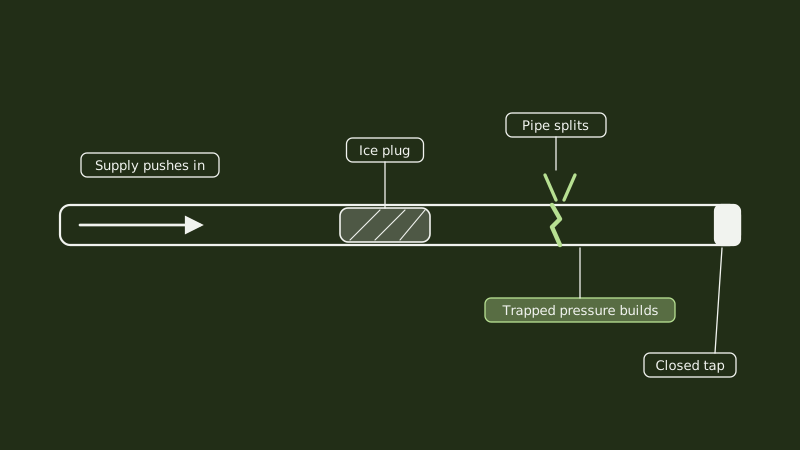
Water expands roughly 9 percent on freezing, and that growth squeezes the remaining liquid against a shut tap until the pipe wall gives. That is the winter story. Santa Ana rarely gets hard freezes, so the splits you meet here usually come from pressure, water hammer, corrosion or tired old pipe. For repairs, the hub on leaks and burst pipes is the next stop.
You will find the mechanics of a frozen split, the year-round causes, how a summer failure differs, the clues on walls and ceilings, and the sequence to follow when one lets go.
Do pipes freeze and burst in Santa Ana at all?
Occasionally, and not where you would guess. Coastal Orange County seldom sees a hard freeze, so buried and interior pipes stay safe. Trouble starts with exposed runs: a pipe along a garage wall, a hose faucet with a hose still attached, lines in an attic or under a raised floor. One clear, cold night can be enough.
Local contractors describe a repeating story. A forecast dips close to freezing, nobody wraps the faucet, and the damage appears later, once things warm up. Homes built with little pipe insulation have less margin than houses in colder states, where builders plan for ice.
Inland foothills and canyons run colder than the flatlands. In the city proper, you only need to act when forecasters call for a freeze: wrap exposed pipe, unhook garden hoses, and let one faucet drip overnight.
What actually makes a frozen pipe split?
The split usually forms away from the ice. A plug of ice seals the line, the remaining water is trapped between that plug and a closed tap, and nothing lets the pressure out. It climbs until the weakest stretch of wall tears. Pressure from trapped liquid, not the ice pushing outward, does the damage.
Both Live Science and an insurance risk guide give this account. It is why a faucet left dripping protects a pipe: the open tap gives the squeezed water somewhere to go.
It also explains the timing. A split can hide while ice still blocks the pipe, then the flow begins as the ice melts. After any freeze, look over exposed pipes once the weather warms, even if nothing dripped overnight.
Which causes matter when nothing is freezing?
Day-to-day, five things wear a pipe down: static pressure above the code ceiling of 80 psi, surges from fixtures that slam shut, corrosion from inside, simple age, and movement in the ground around buried lines. Any one can bring a failure on an ordinary afternoon, and they often work together.
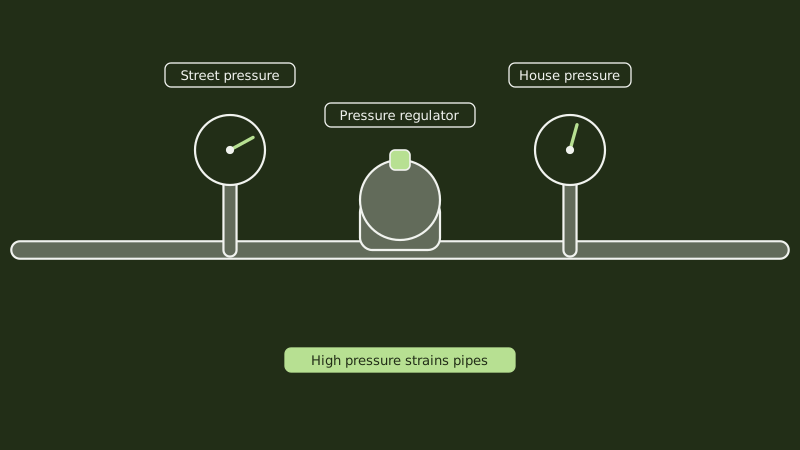
- Pressure. Street supply can run strong, and a house with a failed regulator carries that load nonstop. Section 608.2 of the 2025 state code deals with this. Details are in adjusting or changing a regulator.
- Surges. A washer valve or a toilet's fill mechanism snapping shut sends a shock wave down the pipe. Repeat it thousands of times and fittings loosen. The water hammer sound page covers cures.
- Corrosion. Many Santa Ana houses date to the twenties through fifties and may still hold galvanized steel, which rusts from within. Old copper pinholes. The city lists local hardness near 250 parts per million, so scale narrows and roughens pipe as well.
- Soil movement. Settling, nearby digging and heavy loads strain buried lines.
- Workmanship. A joint that never seated fully can fail years after it was made.
Why do pipes burst in summer?
Heat alone seldom does it. Overnight, when demand falls, supply pressure often rises. A water heater firing in a closed system pushes pressure up through thermal expansion. Garden irrigation lines meet shovels and tree roots. Pipe that was already weak simply finds its limit whenever stress peaks, and that can be July.
Closed systems deserve a note. If a house has a regulator or check valve at the main but no expansion tank, each firing of the heater raises pressure with nowhere to relieve it. Seasons of that fatigue show up first as a weep at a joint, then a split.
Hot weather also moves water use outdoors. A cut sprinkler line can drop house pressure suddenly, and people blame the plumbing inside before they check the yard.
How can you tell a pipe has failed, or is close to it?
Watch for brown or bubbling patches on ceilings and walls, spongy drywall, a hiss or trickle when no tap is open, weak pressure, a meter dial that creeps with every fixture idle, and a sudden bill spike. A ceiling stain that spreads or sags is urgent.
Try the meter test: close every tap, stop the washer and dishwasher, then watch the small dial or flow triangle on the meter for a minute. Any motion means water is escaping. For more clues, see the longer list in recognizing a burst pipe, and for stains above you, a ceiling water leak and what to do.
What comes first once water is flowing where it should not?
Close the main shut-off, then open the lowest tap to let the line drain. Stay clear of panels, outlets and appliances that sit near the water. Photograph the damage before you clean up, move valuables out of the splash zone, and phone a plumber. Never stand beneath a ceiling that is bulging.
Know the main valve location before an emergency. Look at the front wall, the garage or the spot beside the meter. A round handle turns clockwise to close, and a lever closes with a quarter turn. If water has reached an outlet or the panel, keep out of the room and cut power only if the breaker can be reached on dry ground.
Gas involved, or a smell in the air? Everyone goes outside, then SoCalGas gets the call on 1-800-427-2200. If water is flowing now, the urgent burst pipe visit page explains how we set one up. For money questions, there is the burst pipe repair cost guide and a separate note on insurance and burst pipes.
When is it time for a plumber, and which cases cannot wait?
Straight away for active flooding, a leak behind drywall or under the slab, a sagging ceiling, or a repeat leak in one place. A plumber can trace the source with moisture tools, open the wall where it counts, replace the failed section and test the pressure to learn why it happened.
Patching only the break leaves the cause in place. A new section on a line running at 110 psi will fail again. Have the plumber read the pressure and inspect the remaining pipe for similar age and wear. To start, send the price request form. Our other trades are listed on the Santa Ana Plumbing Co home page.
Common questions
How low does the temperature need to fall before pipes freeze?
The freezing point is 32 degrees Fahrenheit, but a sheltered pipe usually needs hours below it. Exposed pipes freeze first: outdoor lines, unheated garages, vented attics. In Santa Ana the danger is a rare clear night near freezing, not an ordinary winter day. Drip a tap and wrap vulnerable pipe when a cold forecast arrives.
Can a pipe fail with no earlier sign?
It can. Corrosion or pressure fatigue sometimes gives way without a stain first. More often there are clues for weeks: a patch of damp, a musty smell, a bill that creeps upward, a meter that never settles. Checking the dial with every tap closed, and looking at ceilings after heavy use, catches many leaks early.
What is worth asking before work on a burst pipe begins?
Find out what the visit includes, whether the price is flat or hourly, and who patches drywall after the plumbing is done. Ask if pressure gets tested after the fix. Take down the contractor license number and verify it through the state board before anyone cuts into a wall.
Does someone need to stay at the house?
Yes, ideally. Someone should show the plumber the shutoff and the damage and agree the plan and the price. Water is off during the repair, so the visit tends to take much of the day. Keep a phone close in case the plumber has questions about the walls.
Sources
- Live Science, why freezing pipes burst
- Utica National Insurance Group, preventing burst pipes
- California Plumbing Code 2025, section 608.2 Excessive Water Pressure
- Wikipedia, Hydraulic shock
- City of Santa Ana, water quality FAQs
- Orange County plumbing contractors on cold snaps and exposed pipes (read November 2026)
Last updated