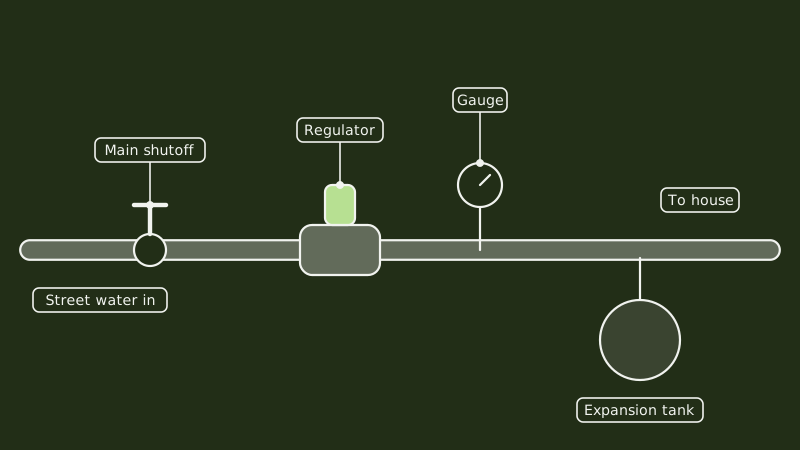
Follow the supply pipe back to the spot where it comes through the wall. Many Santa Ana homes keep the regulator close to the main shut-off, on a front wall, in the garage, or by the meter: a brass valve roughly bell-shaped, topped by a bolt and a locknut. Loosen the nut, turn the bolt, and read a gauge screwed to an outdoor spigot. That is the whole adjustment. A valve that will not respond, or weeps, needs replacing, and the bigger picture of low water pressure at home helps you decide.
You will find below what the valve does, how to test before touching it, what the code says, and where a homeowner should stop. Plumbers also get a lot of calls about showerheads and RV hose-end gadgets that carry the same name but do something different, so that is covered too.
Where does a house hide its pressure regulator?
With city water, the regulator sits on the main supply line just past the shut-off valve, usually where the pipe rises through the slab or wall. Check the garage, the front exterior wall, a crawl space if one exists, or a box beside the meter. Look for a brass body with a dome on top.
Some houses never got one. Pressure from the street can be high, and older homes in particular may have been plumbed without a regulator, or had it removed after it clogged. Our page on where a water pressure regulator is located describes the usual layouts.
If you cannot find it, test first. A cheap gauge threads onto an outdoor spigot. Read it while every other tap is shut. Anything above 80 psi calls for a regulator under the state plumbing code, and the typical target sits well below that.
How many years does a regulator keep working?
Contractor guides commonly say 10 to 15 years, though hard water and sediment can shorten that, and a few last much longer. The sure sign is behavior, not age: pressure that creeps up overnight, a bang when you shut off a tap, a dripping relief valve at the water heater, or pressure that has fallen to a trickle.
Santa Ana's water is hard. The city puts it around 250 parts per million. Minerals and grit collect on the valve seat and inside the screen at the inlet, which is a reason regulators here can wear out faster than the printed life of the part. A flush of the strainer can restore flow on some models, but a valve that no longer holds its set point is finished.
Watch for these symptoms:
- A gauge reading that climbs past 80 psi while nothing runs.
- A thump or bang at fixtures when water stops, a sign of water hammer.
- A water heater relief valve that drips for no clear reason.
- Pressure that slowly fades at every fixture while the main valve is fully open.
Is adjusting the regulator a do-it-yourself job?
Yes, and ten minutes covers it. Thread a gauge onto a hose faucet outside, loosen the locknut on top, then turn the adjusting screw clockwise for more pressure or counterclockwise for less. Move it a quarter revolution at a time, check the gauge with the taps off, and snug the locknut again.
A common household range is 50 to 70 psi, which is a typical plumber's target and not a code number. The code ceiling is 80 psi. Many people crank the screw for a stronger shower and end up with a bang in the walls and a short-lived washing machine. Raise it in small steps and stop when the shower feels right.
Notes on the process:
- Shut every tap and appliance so you read static pressure, not flowing.
- Read the gauge before you touch anything and write it down.
- Make small turns. Wait thirty seconds after each.
- Test again with a tap open for a moment, then closed.
- Snug the locknut so the screw stays put.
Adjustment does not cover a failed valve. If the number will not move, or it creeps back up on its own, replacement is next.
What does swapping in a new regulator involve?
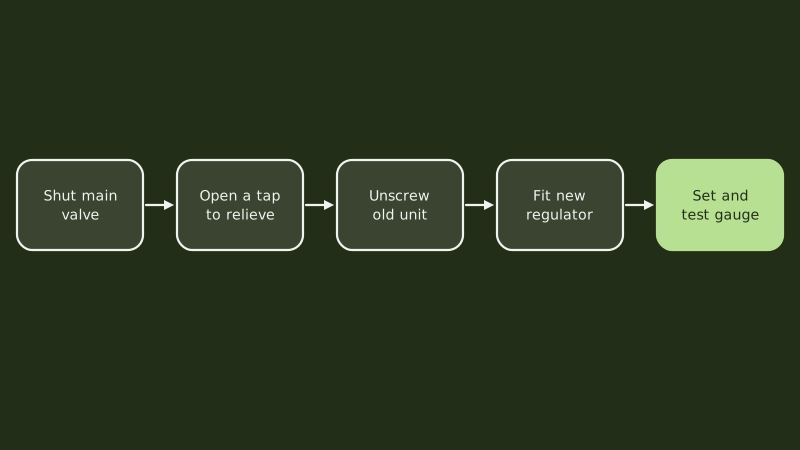
A swap means closing the main, draining the line, cutting out the old valve, joining in a new one with unions or soldered, threaded or push-fit joints, and then restoring water and testing. It is plumber work in most cases: the main is under pressure, joints matter, and an expansion tank may be required downstream.
Section 608.2 of the 2025 state plumbing code (in effect from January 1, 2026) deals with excess pressure. Above 80 psi static, an approved regulator preceded by a strainer must bring the supply down to 80 or less, and a tank for expansion goes downstream on the cold side unless a designer specifies relief valves. Regulators for home use meet standards such as ASSE 1003.
Permits are a local question. The City of Santa Ana's permits counter is the place to ask whether swapping one needs a plumbing permit at your address. Because the job connects to the main line, a plumber will usually add a shut-off valve and a union either side so the next replacement is simpler.
For the price side, see what replacing a regulator costs and the longer note on water pressure regulator replacement.
What other devices get called a water pressure regulator?
Several things share the name. A showerhead flow restrictor limits how much water leaves the head, but it does not control line pressure. An RV hose-end regulator, such as the small inline units sold for camper hookups, protects a trailer's lighter plumbing. A well pump pressure switch cycles a pump on and off. None of these replaces the main valve.
If your house runs on city water, the one that matters is the brass regulator at the main. Inline hose regulators are fine for a garden hose or a camper, and a shower restrictor can be removed or swapped, but they will not protect the pipes in your walls.
Water softener or filter systems with pressure drop are a separate story. If pressure fell right after a new filter went in, check the cartridge before blaming the valve. For other causes, why the pressure drops lists them in order.
When a regulator replacement is on the cards, or the gauge shows a number you do not trust, use the price request form to tell us what you found, and we arrange a visit. Our full service list sits on the Santa Ana Plumbing Co home page.
Common questions
What water pressure is normal for a house?
Plumbers commonly aim for 50 to 70 psi at the house. The state code treats 80 psi as the ceiling for static pressure, and a regulator becomes mandatory above it. Below about 40 psi, showers and washing machines feel weak. A gauge on an outdoor spigot shows which side you are on.
Does a regulator need an expansion tank?
Often, yes. A regulator can trap pressure from thermal expansion when the water heater runs, so the code calls for an expansion tank downstream of the regulator, or relief valves where a contractor designs the system. A tank hanging off the water heater supply is the usual answer.
Why does my pressure go up at night?
Pressure creep is a classic failure. A worn valve seat lets street pressure leak past the regulator while nobody is using water, so the gauge rises toward the street number. If your reading climbs overnight, or a relief valve drips, the regulator needs replacing, not adjusting.
Who should replace it?
In most cases, a contractor with a California plumbing license number you have checked. The main line is under pressure, expansion tank sizing matters, and permits can apply. An owner can adjust the screw. Cutting into the main is a different level of risk, and a leak in the wall can cost far more than the labor.
Sources
Last updated