Fountain Valley grew fast in the 1960s and 1970s, and its plumbing reflects that: roughly four out of five homes went up before 1980, mostly as detached single-family houses on a regular street grid. The city runs its own water department and pumps its own groundwater. A plumber from the area, arranged through us, looks at the problem first and quotes in writing. For the wider map, see the areas page, or use the quote form to send details.
Which decades built Fountain Valley, and what is in the walls?
The city's 2014-2021 housing element, using 2007-2011 census estimates, shows 40 percent of homes built from 1970 to 1979 and 37.2 percent from 1960 to 1969. Together that is over three-quarters of the housing. Another 8.7 percent came in the 1980s, and just 2.2 percent date to the 1950s. The same document puts the share built before 1980 at 81.5 percent.
| Decade built | Share of city's homes |
|---|---|
| 1960-1969 | 37.2% |
| 1970-1979 | 40.0% |
| 1980-1989 | 8.7% |
| 1990 or later | about 10.7% |
What that means underground and in the walls: houses from the 1960s are likely to have copper supply and iron or clay drains, while the late-1970s tracts overlap the period when polybutylene gray plastic pipe was being installed. Not every house has it, so check rather than assume, using our page on polybutylene replacement.
The same data counts 14,500 single-family homes, about three-quarters of all units, and 4,276 multifamily units. Mobile homes are only about 2 percent, 391 units. So the typical call here is a ranch or two-story tract house, not a mobile home or a historic bungalow.
How hard is Fountain Valley's water?
Fountain Valley's own water report, issued in 2024 with 2023 test data, shows groundwater hardness averaging 213 ppm, about 12 grains per gallon, with samples spanning 169 to 266 ppm. The USGS calls anything over 180 ppm very hard, which puts the average in that band, and gentler than some neighboring cities.
The report says the city has six wells and one imported connection, and that in 2023 it supplied only groundwater. The pumped water comes from the aquifer under north and central Orange County, which the Orange County Water District manages. For a detail you cannot find in the report, the city's water quality technician takes calls on (714) 593-4624.
In the house, 12-grain water shows up as scale in kettles, on shower heads and on the heater's lower elements, though more slowly than in harder areas. A water softener is optional here rather than a necessity. If you are weighing one, softener plumbing and the page on whether a softener raises your water bill lay out the trade-offs.
What plumbing problems are common in a 1970s Fountain Valley tract house?
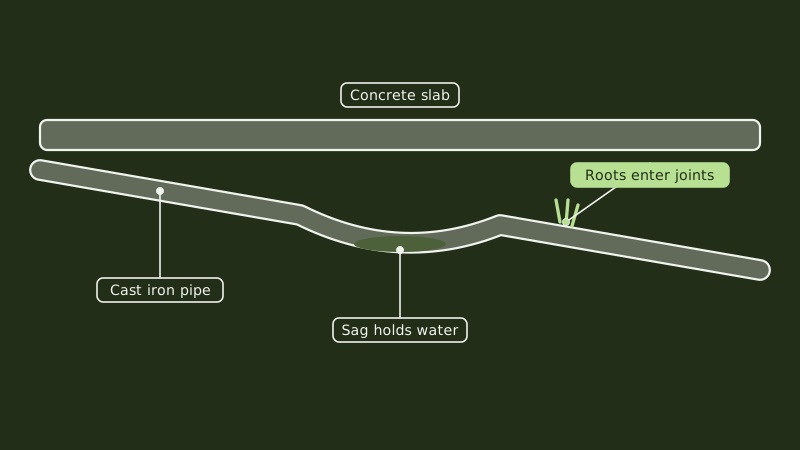
After four or five decades, the repeat offenders are the same across the city's tracts. Pressure is often the first clue: a failing regulator can send street pressure into fixtures and cause leaks at toilets and hose bibs. Next come drains that slow gradually, heaters near the end of their life, and shutoffs that no longer turn.
- Water pressure. A worn regulator can let street pressure into the house. See replacing a water pressure regulator for what the work involves.
- Water heaters. Age is the first check, then rust at the base, damp insulation or a drip at the relief pipe. Learn how often a heater should be replaced.
- Toilets that keep running. Worn flappers and fill valves are an inexpensive fix, covered in fixing a running toilet.
- Water bills that creep. A leak in a buried line, a toilet leak you cannot hear, or an irrigation fault. The usual culprits are in why a water bill jumps.
- Garbage disposals and kitchen drains. Common in family homes with three decades of use.
In a two-story house, water can travel along framing, so a leak may first show as a ceiling stain some distance from the source.
Roughly what should plumbing work run in Fountain Valley?
Costs here follow regional rates, not a city rate card. A heater replacement is about $900 to $3,900 in our cost guide, and labor by the hour is about $75 to $150 in the hourly rate guide. Both name their sources.
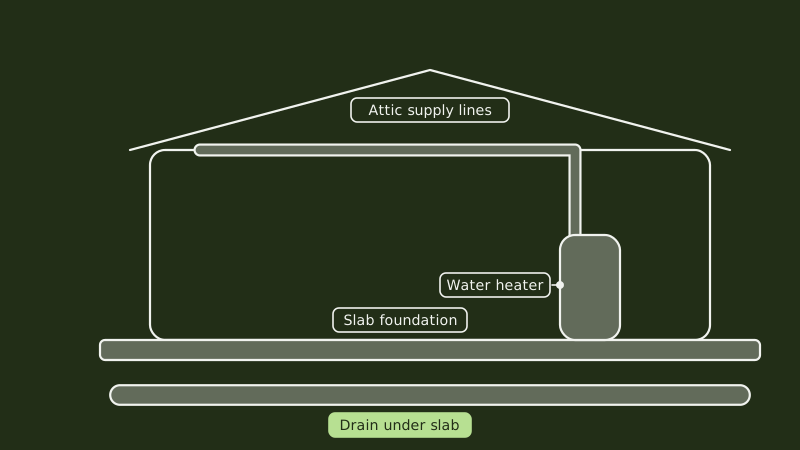
What changes a quote in a 1970s tract: whether the tank stands in a garage, a closet or the attic; whether the replacement unit needs new venting or a pan and drain; how far from the heater the nearest shutoff valve sits; and whether the old shutoff valve still turns. Heater location matters most, since an attic heater adds labor and tools.
Because most homes here are detached, access is usually straightforward. Many homes from this era sit on slabs, and a leak beneath one needs separate investigation. We cannot price that sight unseen, which is why the plumber visits and writes the figure down.
Does Fountain Valley require permits for plumbing work?
Yes, for most changes. Fountain Valley's Building Division says permits are required to install, alter, repair or replace any electrical, gas, mechanical or plumbing system, and its online Permit Center lists a water heater change-out among expedited permits. The plumber normally files it for a replacement.
The Building Division at City Hall, 10200 Slater Avenue, takes calls on (714) 593-4429. According to the city, the counter is open Monday to Thursday and closed on Friday, so plan inspections accordingly. The city also posts a water heater handout. For the steps, our page on how to pull a plumbing permit goes through them, and water heater permit details covers that job.
Gas work is the legal line. California reserves it for contractors who hold a license. Gas odor in the house? Go out, then ring SoCalGas, 1-800-427-2200, from outdoors; 911 if anyone is in danger.
Common questions
Is Fountain Valley water softer than Garden Grove's?
Yes, based on the cities' own reports. Fountain Valley's 2023 groundwater averaged 213 ppm, about 12 grains per gallon, while Garden Grove's 2024 groundwater averaged 316 ppm. Both exceed the USGS threshold for very hard water at 180 ppm. Check each city's current report for updated figures.
How old are most houses in Fountain Valley?
Most are from the 1960s and 1970s. The city's housing element puts 77 percent of units in those two decades and 81.5 percent before 1980. That age is why drain lines, water heaters, shut-off valves and regulators are the common repair calls, rather than new-build problems.
Can I get a plumbing permit in Fountain Valley on a Friday?
Not at the counter, according to the city, which lists the Building Counter as open Monday to Thursday and closed Friday. The city's online Permit Center takes expedited jobs, and a heater change-out is one of them. Call (714) 593-4429 to confirm how the plumber should file.
Should I replace polybutylene pipe in a Fountain Valley home?
If you find it, the usual advice is to replace it, because the pipe is known to fail without warning in chlorinated water. A house built in the late 1970s or 1980s is a candidate, though many have copper instead. Our polybutylene replacement cost page explains typical ranges.
Home base for the whole service is the Santa Ana Plumbing Co front page.
Sources
Last updated