Spell it plumber. Nobody pronounces the b, so plenty of people type "plummer", and search engines quietly fix it for you. If a pipe is leaking right now and you only wanted a name for the trade, the Santa Ana Plumbing Co home page lists our services and the quote page takes the details of your job.
Still here for the trivia? Good. What follows covers the odd spelling, the difference between a plumber, a pipefitter and an HVAC technician, who takes home more, and which of them belongs under your house or in your attic.
Is it plummer or plumber?
Plumber, always. "Plummer" turns up as a family name and as a typo, and a plummet is a drop. The silent b is not decoration. It sits there because the word descends from Latin plumbum, meaning lead, the metal Romans hammered into roof sheeting, bath drains and water pipes.
English kept the b and the job. By the Middle Ages anyone who worked in lead was a plumber. Chemistry kept the root too: lead is Pb on the periodic table.
A plumb line, the string with a weight that hangs true, got its name from the same lead bob. So the quickest memory aid is this: lead, plumbum, plumber, plumb line. One b each time.
What does a plumber do all day?
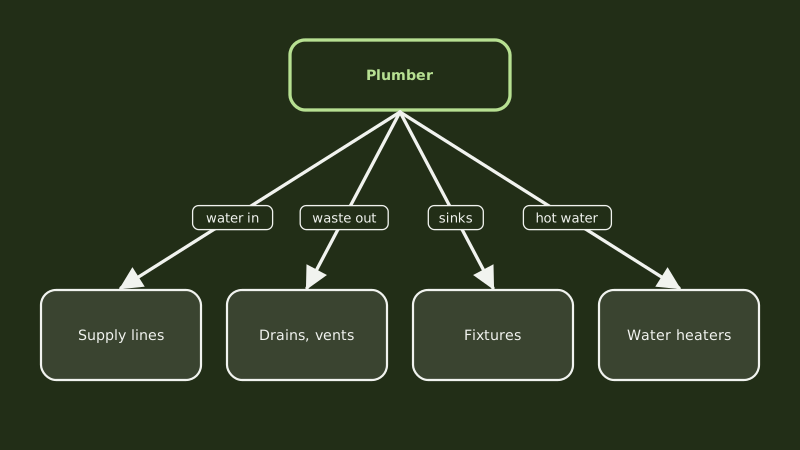
Plumbers lay out, install and repair the pipework that delivers clean water, carries waste away and, in California homes, feeds gas to the stove and water heater. A typical week includes clearing blockages, setting toilets and faucets, hunting leaks, swapping water heaters and replacing worn-out pipe. One or two people usually handle a house.
The Bureau of Labor Statistics frames home work as water and gas piping, fixtures like tubs and toilets, appliances like dishwashers and water heaters, and clearing drains. Tools range from a soldering torch to a camera on a cable.
Santa Ana adds its own flavor. A lot of the housing here was built between the 1920s and the 1950s, so calls often involve steel supply pipe corroded from within, pitted copper, or aging cast iron and clay sewer lines. Two of our pages show where that leads: redoing the plumbing of an older home and what a maintenance plumber handles.
Pipefitter or plumber: which one earns more?
Nobody can say from federal data, because the Bureau of Labor Statistics counts plumbers, pipefitters and steamfitters as a single group. That group's median pay was $63,800 a year, or $30.67 per hour in May 2025. Industrial pipefitters often out-earn home plumbers, but the national table does not show by how much.
Both trades cut, join and test pipe, so people lump them together. The split is the setting. Plumbers work on houses, shops and offices. Pipefitters and steamfitters work in factories, power plants and the heating and cooling loops of large buildings, where pipe may hold chemicals, steam or gas under high pressure. Some become gasfitters or sprinkler fitters.
Training is long for both: four to five years of apprenticeship, around 2,000 paid hours a year on the job. Pay then swings with union membership, overtime, on-call duty and the local market. What a customer pays per hour is another number again, since it carries the truck, the tools, insurance and the shop. See plumber pricing per hour for that side.
Does an HVAC technician earn more than a plumber?
Slightly less, on the national median. For May 2025 the Bureau of Labor Statistics shows heating, air conditioning and refrigeration mechanics at $29.33 an hour against $30.67 for the plumbing group. A dollar-odd gap is within what specialization, overtime and employer would erase, so neither trade is clearly the better paycheck.
Heating and cooling versus water and waste: that is the dividing line. They bump into each other at a few points inside a Southern California house.
- Gas appliances. A shutoff valve feeds a furnace or a water heater, and both need a vent to carry exhaust outdoors. Running the gas pipe is plumbing. Furnace controls and ducts are HVAC.
- Condensate drains. An air conditioner sweats, and that water needs a drain. The drain line counts as plumbing.
- Attic air handlers. They need a drain pan and a clear path for condensate, and when either fails the stain shows up on a bedroom ceiling.
California treats them as different classifications. The state contractor board has one for plumbing and another for heating and air conditioning, so a plumber does not automatically cover a furnace swap, and an HVAC outfit does not automatically cover new drain lines. Look the classification up on the board's license search before you agree to either job.
Which trade handles pipes under the house or up in the roof space?
A plumber. Water supply, drains and water heater connections up in an attic or down in a crawl space are plumbing, even when ducts and wiring share the space. Cramped access is what raises the price, since every fitting takes longer when the worker is lying on their back, and a quote should say so.
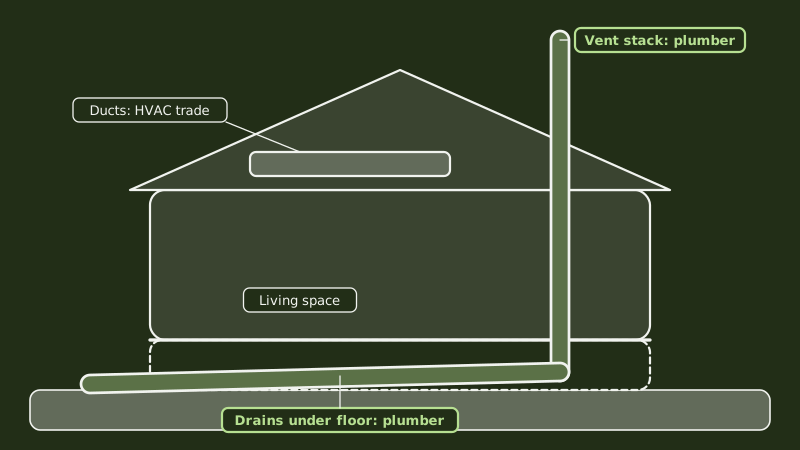
Santa Ana's housing mixes two foundations. Many older houses stand on raised floors with a crawl space underneath, where drain lines can be inspected. Many postwar tract homes sit on concrete slabs, where the pipes run under the floor and a leak becomes a different kind of job. Our page on why water bills spike helps you tell whether a hidden leak is the culprit.
If you want a quick look yourself:
- Insulation hides trouble. Matted batts, a ceiling stain in the room below or a sudden rise on the water bill may be all you get.
- Take a dust mask and a flashlight, and mind loose wiring and nesting wasps.
- If old pipe wrap looks like asbestos, stop. Have it tested before anyone touches it.
Can just anyone call themselves a plumber in California?
For small jobs, anyone can. The state contractor board raised its no-license ceiling from $500 to $1,000 in January 2025, counting labor and materials together. Above that, or whenever the work calls for a building permit, California wants a contractor license, and plumbing is its own classification.
Earning that license is slow. The board asks for four years at journey level in the trade, with up to three of those years allowed to come from apprenticeship or technical schooling, then exams, fingerprints and a bond.
The practical test is simple. Anyone who offers to "do a bit of plumbing" for cash and no paperwork is outside the law on anything that needs a permit. Swapping a water heater and repiping a whole house are two that do. We explain the process in pulling a plumbing permit.
Common questions
How long will a plumber be at the house?
Swapping a faucet cartridge or toilet flapper, or clearing a small clog, may finish within a couple of hours. A water heater takes most of a morning or afternoon, and repiping a house spreads over several days. Walls and concrete floors make timing less certain, so ask which part of the job could stretch the schedule.
What should I settle before saying yes to a plumbing job?
Pin down the contractor license number and look it up at the state board. Learn what the price includes and whether the job needs a city permit. Then get the answer to the awkward one: how does the price move if the pipe inside the wall has aged badly?
Does someone have to stay at the house while the work is done?
Yes, an adult, on arrival, to show the leak or clog and the main valve, and again near the finish, to inspect what was done. Between those moments the plumber mainly needs a clear route to the fixture. If you cannot be there, send a trusted adult and tell the office beforehand.
Is there any case where "plummer" is correct?
Only as a surname, or as a slip of the keyboard. Search engines read it as plumber and show the same results either way. On a quote request or a work order, though, write plumber with its b, so a person reading your note never wonders what you meant.
Is gas pipe a plumber's job?
Yes. A plumber holding the right California contractor classification fits and repairs the gas piping that serves water heaters, ranges and furnaces, and homeowners should leave it alone. Smelling gas? Go outdoors, ring SoCalGas from there (1-800-427-2200), and use 911 for anyone in danger.
Sources
- Wikipedia, Plumber (word origin and scope of the trade)
- BLS Occupational Outlook Handbook, plumbing and pipefitting trades
- BLS Occupational Outlook Handbook, heating and air conditioning trades
- CSLB press release on the 2025 minor work limit (AB 2622)
- Published plumber hourly rate guides, checked November 2026
Last updated