
Most national price guides put commercial plumbing at roughly $90 to $200 per hour, with an average near $140, and after-hours calls at $150 to $300. Those are billed rates, which cover wages, insurance, tools, the truck and overhead, so they run far above what a plumber takes home. For a restaurant, office or retail unit in Santa Ana, only a written quote gives the true price. If you are working out which kind of help you need, our page on commercial plumbing in Santa Ana explains the services, and this page covers the hourly math.
What is a typical hourly rate for a commercial plumber?
Published guides cluster around $90 to $200 an hour for commercial work, with one common average at $140 and a few union-influenced markets quoting $120 to $250. Residential work is billed lower, often about $80 to $100 an hour. After-hours and emergency visits typically bill at one and a half to two times the standard rate.
Do not lean on one number. The guides are national consumer surveys, not Orange County price lists, and local labor and insurance costs may sit above the national middle. Federal wage statistics (the Bureau of Labor Statistics follows plumber pay) show what workers earn, not what customers pay, but a quote barely above hourly pay is a warning sign.
Older numbers such as a 2022 hourly rate are out of date. Material and labor costs have moved since, so use current quotes. Searches for rates in New Zealand or other countries do not apply to a Santa Ana building either.
| Type of rate | Guide range (per hour) |
|---|---|
| Residential service | About $80 to $100 |
| Commercial, standard hours | About $90 to $200 |
| Commercial or emergency, after hours | About $150 to $300 |
| Service call or diagnostic fee | Often $50 to $250, sometimes covering the first hour |
How do master and journeyman plumber rates compare?
Guides commonly list a journeyman at roughly $60 to $150 an hour and a master plumber at roughly $90 to $200, a premium of around $40 to $50. Those labels describe skill and supervision level. In California, the license that matters to a customer is the contractor's license, so ask which person will do the work and who holds it.
On a commercial job, a plumbing company may send a journeyman for routine work and keep a more senior person on larger or code-heavy tasks such as backflow, gas or water heater changeouts. Apprentices bill lower where they are used. When the scope is clear, a flat price for the defined task can beat a pure hourly rate.
In California, plumbing is done under a C-36 contractor license, and the state lets you look a license up before you hire. Check the number at the state contractors board. The law demands the license once a job is valued at $1,000 or more, or when a permit comes into play.
What affects a commercial plumber's hourly cost?
Hours of the day, urgency, building type, access, the scope of work and whether a permit is involved all shape the rate. A night call to a restaurant with a failed grease line costs more than a scheduled fixture swap at midday. Older buildings with mixed pipe or hidden shutoffs take longer than newer ones.
Other drivers:
- Minimum charges. Many shops bill a minimum of one or two hours, so a ten-minute fix is not billed as ten minutes.
- Travel and trip charges. Some quotes add drive time; ask whether it is included.
- Parts and markup. Commercial valves, backflow assemblies and water heaters cost more than residential ones, and markup differs between companies.
- Specialty equipment. Camera inspection, jetting and locating gear may be billed on top.
- Permits and inspections. City of Santa Ana permits for gas, water heater or backflow work add fees and time.
- Access and safety. Work inside an occupied restaurant or a tenant space after closing, with lockout rules, takes planning.
Compare it with how a maintenance plumber works for a regular contract: planned visits are often priced per visit, not per hour, and cost less per fixture than emergency calls.
How can I work out the cost of a job from an hourly rate?
Multiply the hourly rate by the estimated hours, add parts and any minimum charge, then add permit fees and tax where they apply. Any online calculator depends entirely on the hours guess, so have the plumber say how long they expect and what is included.
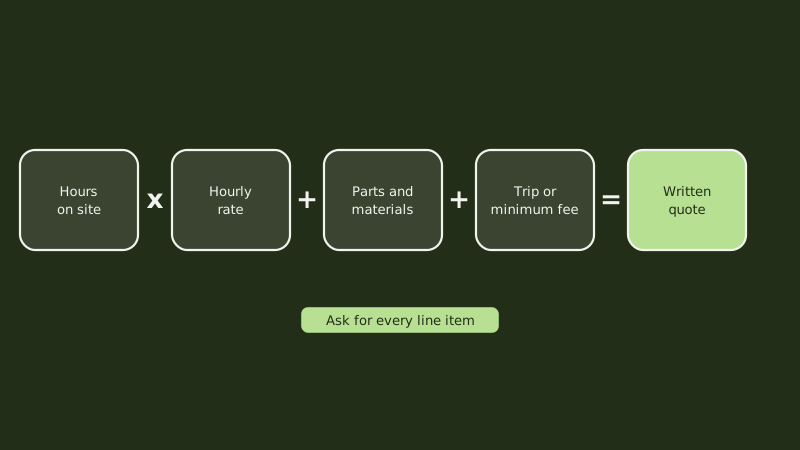
A worked example, with invented round numbers for illustration only: a $140 hourly rate, a two-hour estimate and $180 of parts gives $460 before any permit. If the plumber needs a third hour, a one-hour minimum has already been absorbed, but a ten-minute trip back for a missing part may not be free. Ask.
Big projects like a repipe or a new gas line are a poor fit for an hourly figure. Ask for a fixed bid with a scope list, then compare bids on scope as much as price. The guide on what plumbers cost per hour covers the residential side, and service call fees explains the callout charge separately.
How should I compare commercial plumbing quotes?
Put the same list to every company, in writing: rate, minimum, trip charge, after-hours multiplier, parts markup and exclusions. Add the contractor's license number to the list and look it up yourself. A cheap rate paired with a long minimum and heavy parts markup may cost more in the end than a pricier, plainer one.
Ask for the scope in plain terms. "Clear a main line" may or may not include a camera look. "Replace a water heater" may or may not include permit and haul-off. Check insurance details too, since commercial properties often require a certificate of insurance from any contractor on site.
Think about the long run. A company that can handle gas, backflow testing and routine maintenance may save you coordination. For test-and-report work, see backflow testing rates, which is usually priced per device and not per hour.
Common questions
What does a commercial plumber charge for an emergency?
After-hours and emergency commercial calls are commonly billed at $150 to $300 an hour in national guides, or at one and a half to two times the normal rate, often with a minimum charge. Weekends and holidays sit at the top. Ask for the multiplier and the minimum before the plumber starts, not after.
Is the hourly rate the whole price?
No. The hourly rate covers labor. Parts, permits, equipment such as cameras or jetters, travel charges and sales tax come on top, and many shops bill a minimum of one or two hours. Ask for a total estimate that lists labor hours and parts separately, so you can compare two companies fairly.
How long should a commercial plumbing job take?
It depends on the job. A fixture swap or a small leak can be an hour or two. A main-line clog with camera work may take half a day. Water heater replacement, gas work and permitted jobs often involve a second visit for inspection. Ask for an estimate, and ask what causes it to change.
Does the business owner have to stay on site?
A person with decision power should be reachable for access, change approvals and the final handover. In a shop or restaurant, that is a manager or the owner. For evening jobs, arrange a key or alarm code beforehand and settle in writing who locks up.
Budget sorted? plumber across Santa Ana explains the rest of the job.
Sources
- Published plumber hourly rates from several national cost guides, checked November 2026
- US Bureau of Labor Statistics, Occupational Employment and Wages, plumbers
- California Contractors State License Board
Last updated