Santa Ana's water is hard enough to leave white crust on a showerhead within weeks. The City of Santa Ana's own water quality page puts hardness near 250 parts per million, about 15 grains per gallon, and the USGS calls 181 mg/L and up "very hard." Inside a salt softener, resin beads trade the calcium and magnesium for sodium. Salt-free types work differently and aim to change how scale forms.
Buying the tank is simple. Piping it so it works, drains properly and leaves pressure intact is where plumbing skill counts. A plumber local to you is sent to inspect your lines and the spot you have picked, then writes up the cost. Describe your setup on the quote page, or read on.
What happens during a softener installation?
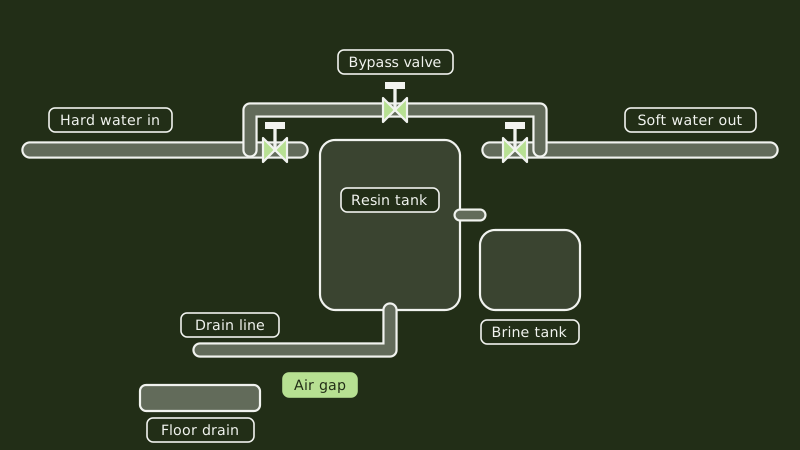
Water goes off, the supply line is cut before the water heater but after the outdoor spigots, and a bypass valve set goes in so the house can run on untreated water when needed. Inlet and outlet hoses connect to the unit. A drain line carries the regeneration discharge away, and the head is plugged in, programmed and flushed.
Order matters. Outdoor spigots usually stay on hard water, since softened water is hard on lawns and burns through salt. The softener goes on the line feeding the water heater and the bathrooms. Some homes were built with a "softener loop," a pre-plumbed section of pipe with stub-outs and valves, and in those the job is mostly connecting hoses.
The sequence on a typical visit:
- Find the right tee on the supply line and close the main.
- Cut, then fit the bypass valve set so the house can run on hard water during service.
- Connect inlet and outlet in the right direction. Reversed connections are a classic do-it-yourself mistake, and salty-tasting water is the first symptom.
- Run the drain line to a laundry standpipe, floor drain or utility sink with a proper air gap. The gap stops sewer water from backing into the softener.
- Plug in, set hardness, start a recharge, then flush and check every joint for drips.
What will a plumber charge to put in a softener?
Cost guides show plumber labor spanning about $150 to $1,000, and many jobs close out between $400 and $800. A house with a pre-plumbed loop sits near the bottom, $150 to $400. Unit and labor together usually come to $800 to $3,800, depending on the model.
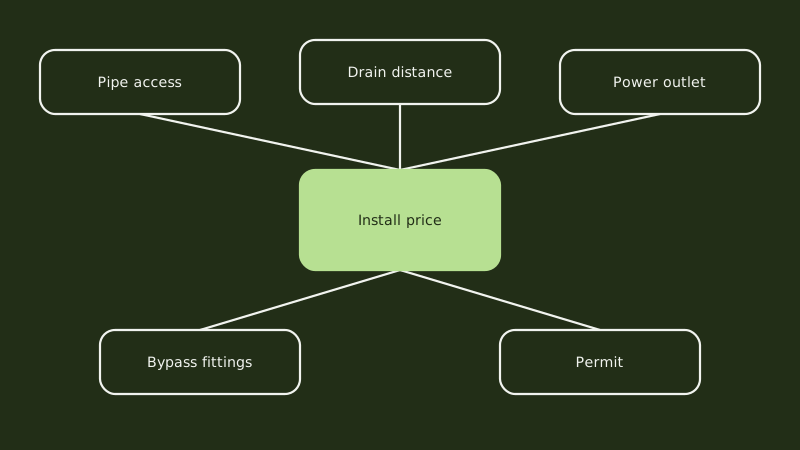
What changes the number is almost never the unit. It is the plumbing around it.
- A softener loop already in the wall cuts labor sharply. None, and the plumber must run new supply lines.
- Distance to a drain. A drain tie-in across a garage costs more than one beside the washer.
- Electrical. The control head needs an outlet. A garage with none adds an electrician's visit.
- Access. A cramped closet or tight corner adds time.
- Permit. A new drain tie-in can need one, so ask.
Dealer packages often bundle unit and installation under one price, so compare the two halves separately. Our page on water softener system installation cost breaks the figures out further. Those are national guides, so only a quote on your own house can settle it.
Does my Santa Ana house really need a softener?
You probably do if the water is very hard and you see the usual proof: white crusty rings on faucets, cloudy glassware, soap that will not lather, and scale inside a kettle. Locally, the numbers back up the symptoms: the city reports that about 77 percent of its supply is local groundwater, with imported supply making up the balance.
Scale is not only cosmetic. The USGS notes that heating hard water leaves calcium carbonate deposits that can narrow pipes, shorten the life of equipment and cut a heater's efficiency. In a Santa Ana house with older galvanized or small-bore copper lines, that buildup can drag down flow. For a walk-through of what to do about the crust itself, start with clearing hard water scale and what removes hard water scale.
A test strip from a hardware store takes a minute. For a number you can trust, use the city's published water quality report, which lists hardness for the system that serves your address. Note that your water source depends on where you live: Santa Ana, Irvine and Huntington Beach are served by different agencies.
Does the brand change the installation?
The brand changes the unit, not the plumbing. Culligan, Kinetico, Whirlpool, Rheem, Aquasana and the box-store lines all follow the same pattern: inlet, outlet, bypass, drain, power. Differences are in controls, efficiency, whether the head meters water use, and whether the dealer insists on its own installer to keep the warranty valid.
Read the warranty before you buy. Some dealers sell and install in one package, some sell a unit and leave you to find a plumber. If you bought a unit online or at a warehouse store and the manual wants "installed by a professional", a local plumber can fit it, provided the model is in good shape and the spot suits it. Ask the plumber to check what the manual says about drain height and clearance.
Two specifics people ask about:
- Softener "shower head" filters are small cartridges, and most filter chlorine instead of softening. Each one treats a single shower and nothing else. Do not expect a scale fix from one.
- Salt-free conditioners claim to change how scale forms rather than remove hardness. Reported results vary, and installation differs from a salt unit, so ask the seller for specifics.
Do water softeners cause problems for a water heater or the water bill?
A softener can help a heater, since scale insulates the heating surface, but it can also change the water chemistry the heater lives in. The Department of Energy notes that some water softening methods speed up wear on a tank's anode rod, so check the rod more often after a softener goes in.
The other side is use. A salt-based softener regenerates on a schedule and flushes some water down the drain each time, a modest amount on a well-set unit. A leak at the bypass, a stuck valve or an overly frequent recharge can inflate the bill. We cover that in whether a softener can cause a high water bill. To keep scale from building in the first place, hard water scale prevention has steps that work with or without a softener, and anode rod replacement covers the tank.
Are there rules in Orange County about salt softeners?
Yes, possibly. California does not ban salt-based softeners, but state law sets efficiency standards for self-regenerating ones and lets a local agency restrict or prohibit them where salt in wastewater is a problem. Before you buy, ask your water district or city whether any local rule applies at your address.
Salt that households send down the drain ends up in the wastewater system, which is why local agencies have a say. A published summary reports that some water districts in the Irvine area have rules on self-regenerating units. I could not confirm the text of any specific local ordinance, which makes it a reason to call the district, not a conclusion. For Santa Ana addresses, the city's Building and Safety Division is the place to ask about permits for a drain tie-in.
Hiring rules apply as well. The state contractor board's $1,000 limit for work done without a contractor counts labor and materials together, and a job needing a permit is outside it in any case, so confirm the plumber's license number with the board.
Common questions
How long does the hookup take?
With a softener loop already in the wall, a plumber can finish in two to three hours. With no loop, no nearby drain and an outlet that has to be added, expect most of a day. The plumber should quote the time along with the price after seeing the spot.
Is a do-it-yourself softener install realistic?
Many people do, and a pre-plumbed loop makes it realistic. The traps are weeping joints, swapped inlet and outlet, a drain missing its air gap, and cutting into the wrong pipe. If any part is in doubt, or the unit needs a permit, have the plumber do it.
What belongs in a softener installation quote?
Look for the bypass valves, the drain run, any permit, and the plan if the first location will not work. Check which warranty covers the unit and which covers the labor. And note the contractor license number so you can search it with the state board before you sign.
Is the water off while the plumber works?
For a stretch, yes. Water is closed off while the plumber cuts in and fits the valves, so fill a few jugs and run the dishwasher first. An adult should be home for the start, to agree the spot, and for the finish, to learn the bypass and salt fill.
Where do I put a softener in a Santa Ana house?
Garages and utility closets are common, near the main line and a drain. Slab homes without much indoor room often use the side yard or garage wall. The spot needs power, a drain within reach and enough clearance to refill salt. Shade is better than direct sun.
Other services we arrange around Santa Ana are listed on the home page.
In this section
- Water softeners
Can a water softener cause a high water bill?
- Water softeners and treatment
What removes hard water scale from faucets, showerheads, tubs and water heaters, which acids are safe on which surfaces, and what stops it…
- Hard water scale prevention
Santa Ana water is very hard by USGS standards.
- Water softeners and treatment
How to remove hard water scale from fixtures, showerheads and water heaters in Santa Ana, and what a softener install involves, DIY or by…
- Water softener installation cost
Water softener installation cost in Santa Ana: typical totals by system type and brand, labor alone, loop installs, and what hard water at…
Sources
- USGS Water Science School, Hardness of Water
- City of Santa Ana, Water quality FAQs (hardness and water sources)
- California Health and Safety Code, Water Softeners article (sections 116775 to 116795)
- U.S. Department of Energy, water heater anode rod and water quality notes
- California Contractors State License Board, AB 2622 minor work limit
- Published water softener installation cost guides, checked November 2026
Last updated