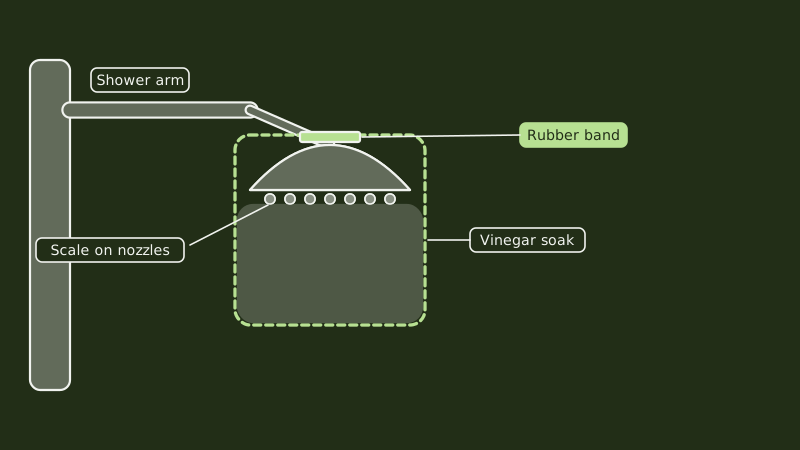
Vinegar, citric acid and store-bought descalers dissolve scale because the crust is mostly calcium carbonate, which acid dissolves. Soak the part, wait, wipe, rinse. That is the whole method for faucets, showerheads and glass. The details that matter are which surface you are cleaning, how long you leave the acid on, and what you do about the water so the crust does not return. If you are weighing a treatment system, start with plumbing for water softener installation, and the rest of our Santa Ana plumbing arrangements sit on the home page.
How do I clear scale off faucets and showerheads without damage?
Let them sit in plain white vinegar or in dissolved citric acid until the crust softens, then scrub lightly and rinse. On a faucet, tie a damp vinegar rag around the spout. A showerhead can ride in a bag of vinegar for a few hours. Look at the maker's care guide first, because certain finishes object to acid.
Step by step:
- Faucet aerator. Unscrew the tip, brush off the crust, and soak it. Rinse and refit. Many low-flow complaints end here.
- Spout and handle. A cloth soaked in vinegar and wrapped around the crusty area works in 30 to 60 minutes. Wipe it clean afterward.
- Showerhead. Remove it, or bag it in place with a rubber band. A couple of hours is typical, and overnight for heavy scale. Poke the nozzles with a pin afterward.
- Rinse well with plain water, and dry with a soft cloth to prevent spots.
Rules of thumb on surfaces: plain chrome, stainless steel and glass cope well with short vinegar soaks. Brushed, oil-rubbed, gold-tone and other coated finishes can dull or peel if left soaking, so use a shorter contact time or follow the manufacturer's instructions. Marble, travertine and some grout etch under any acid, so vinegar stays away from them.
A faucet that drips or sprays oddly after cleaning may have a worn washer or cartridge underneath the scale. Repair steps are in fixing a leaky faucet.
How do I remove scale from tubs, tile and glass?
Spray scale with a fifty-fifty blend of vinegar and water, wait ten to twenty minutes, scrub gently and rinse. For glass shower doors, a vinegar-soaked cloth held against the glass for a while loosens spots. Keep vinegar away from bleach, because together they release chlorine gas.
What works where:
- Glass doors and chrome: vinegar and water, a soft sponge, and a squeegee habit afterward.
- Porcelain and acrylic tubs: vinegar solution or a cleaner made for them, a nonabrasive pad, no steel wool.
- Ceramic tile: vinegar suits the tile itself, yet it can eat cement grout and natural stone, so keep it off them.
- Stubborn crust: a paste of citric acid powder and water, left for a while, or a descaler made for bathrooms, used as the label directs.
Wear gloves, open a window and rinse thoroughly. Do not combine different cleaners. Where acid has touched natural stone and left a dull patch, a stone care professional is the answer, not more scrubbing.
Can scale inside a water heater be cleared out?
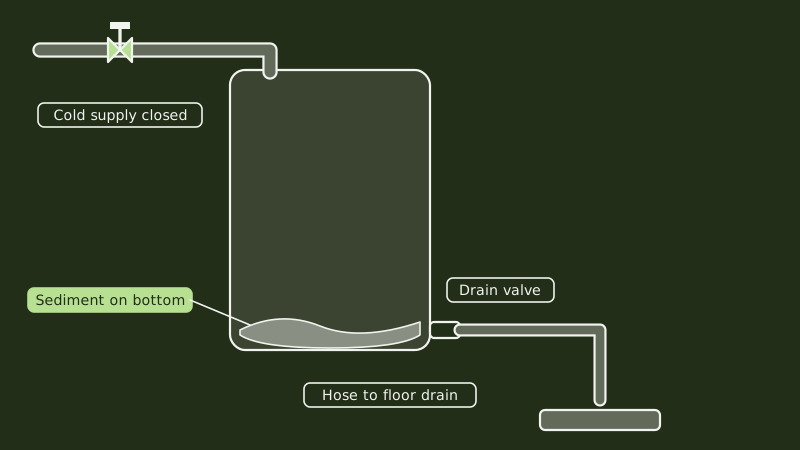
Flushing the tank washes out loose sediment, while electric elements can still wear a crust. Follow the maker's draining steps: switch off power or gas control, close the cold supply, and drain through the valve to a safe place, because the water can be scalding. A plumber can do it if you are unsure.
A few points for water heaters:
- Sediment sits on the tank bottom. On gas units it insulates the water from the burner, and on electric units it covers the lower element. The result is noise, slow heating and shorter life.
- Flushing helps, but only so far. It carries off loose material. Hardened crust stays put, and prying at it risks the tank.
- Elements and anode rods wear in scale. See replacing a water heater element.
- Tankless units need descaling with a circulating acid solution on a schedule set by the manufacturer. That is a service job.
A heater that has stopped heating is a separate matter, and why a house has no hot water lists the checks to run.
How hard is Santa Ana's water, and why does that matter?
The City of Santa Ana reports tap water hardness around 250 parts per million, roughly 15 grains per gallon. The USGS calls anything above 180 milligrams per liter very hard. So Santa Ana water sits in the very hard category, and scale builds quickly on fixtures, in kettles and inside hot water equipment.
For context, the USGS bands are: 0 to 60 mg/L soft, 61 to 120 moderately hard, 121 to 180 hard, and above 180 very hard. Hardness figures change slightly between reports and parts of the system, since some supply is local groundwater and some is imported, so ask for your utility's current water quality report. Hard water is not a health hazard by itself. The harm is to pipes, heaters, fixtures and appliances.
Older Santa Ana houses, built between the twenties and the fifties, may also have galvanized or copper supply lines where scale and corrosion build up together. A plumber can say whether low pressure is scale in the pipes or a different fault. The questions are related to low water pressure from the shower, which often traces to a clogged head.
What stops scale from coming back?
Treating the water is the only real fix. Options are a salt-based softener, a salt-free conditioner that changes how scale forms, or a whole-house system with a filter. Routine descaling of fixtures is the stopgap. A softener removes the minerals, while conditioners reduce adhesion without removing them.
Choices in plain terms:
- Salt-based softener. Exchanges the calcium and magnesium for sodium. It is the most effective against scale, though it uses salt and discharges brine. More in getting rid of hard water scale and preventing scale.
- Salt-free conditioners. Change the scale into a less sticky form. Results vary by product and water.
- Point-of-use measures. A showerhead filter or a descaled kettle. Limited, but cheap.
One local point: California has no statewide ban on salt-based softeners. A state law, AB 1366, lets local agencies restrict self-regenerating units where brine harms wastewater recycling, and one city-by-city guide reports restrictions in parts of Irvine while finding none for Santa Ana. Confirm with your own water or sanitation agency before buying one.
For what a system costs, see water softener system installation cost, and for the effect on bills, whether a water softener can raise a water bill.
When does scale become a plumber's problem?
Reach out when scale has clogged pipes or a regulator, when the water heater is noisy or slow, when a fixture will not come clean, or when you want a treatment system. A plumber can read pressure, flush a heater and size a softener. The visit is arranged by us, with the price agreed in writing first.
Ask any contractor to put the scope in writing and to give a license number. A softener installation often reaches the $1,000 level at which the state requires a contractor license. Look the number up on the state board's site.
Common questions
Does vinegar remove hard water scale?
White vinegar dissolves light scale on faucets, showerheads, glass and tile, usually after a soak of 30 minutes to a few hours. It struggles with thick, old crust, and it can etch natural stone or dull some finishes. Test on a hidden spot first, and never mix it with bleach.
How do I get hard water scale out of a kettle or coffee maker?
Fill with half vinegar and half water, heat or run it through, let it stand, then rinse several times. Citric acid also works. Follow the appliance maker's cleaning instructions, since some brands specify a particular descaler. Run plain water through afterward until the smell is gone.
Can hard water damage my plumbing?
Over time it can. Scale narrows pipes, clogs aerators and showerheads, coats water heater elements and heat exchangers, and shortens appliance life. It rarely causes sudden failures, but it contributes to low pressure, noisy heaters and higher energy use. A plumber can look at your specific pipes and heater.
Is a water softener worth it in Santa Ana?
With water the city reports as very hard, a softener can reduce scale a great deal, though it costs money, needs salt and maintenance, and may be restricted by local rules. Whether it pays off depends on your house and use. A plumber can size one and quote it in writing.
Does boiling water remove scale?
No. Boiling water makes dissolved calcium come out of solution and form scale, which is why kettles crust up. Descaling needs an acid such as vinegar or citric acid. Plain hot water will not dissolve it. For deposits on fixtures, soak and wipe as described above.
Sources
- USGS Water Science School, hardness of water
- City of Santa Ana, tap water hardness
- California Assembly Bill 1366 (2009), residential self-regenerating water softeners
- Manufacturer care instructions for faucets, showerheads and water heaters (check your own model)
Last updated