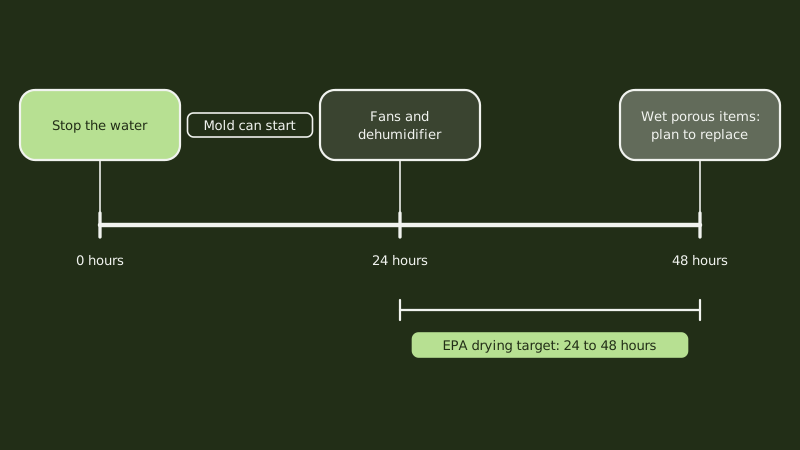
The pipe is stopped, and now a different clock runs. EPA guidance is to get wet building materials dry inside a day or two, or mold gets going. Drywall, carpet pad and insulation soak fastest and are the first to fail, while solid wood framing and concrete usually dry out. This guide follows the damage, room by room. The plumbing side, closing the main and repairing the pipe, is on the burst pipe page.
Santa Ana's warm climate speeds mold growth in damp, closed spaces, so a closet wall that stays wet is the usual surprise.
How fast does mold start after a pipe bursts?
Mold can take hold in damp materials within a day or two, which is the reason for the EPA's drying target of 24 to 48 hours. The sooner water is removed and air moves across wet surfaces, the better the odds that materials can be saved. Mold that has already spread is a cleanup job.
Fans, open windows and a dehumidifier speed drying. The EPA suggests keeping indoor humidity below 60 percent, ideally between 30 and 50 percent, and a cheap humidity meter shows where you stand. If a closed wall cavity cannot be reached, a restoration company can dry it with specialist equipment.
Which things survive a soaking, and which are trash?
Tile, concrete and solid wood usually dry out and stay. Carpet padding, insulation, particleboard and drywall that have sat wet beyond a day or two often have to go. Carpet may be saved if it is lifted and dried quickly, while mold-prone porous items are hard to clean fully.
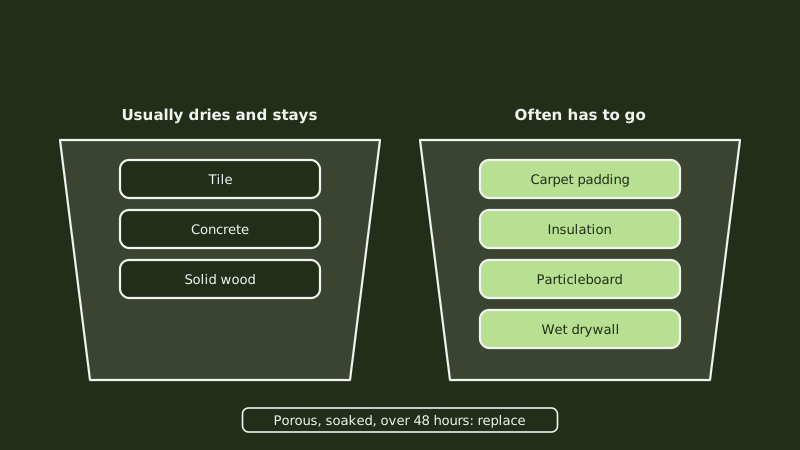
Use a simple rule: if it is porous, soaked and more than 48 hours old, plan to replace it. Take photos before disposal for the insurer. Furniture legs on wet flooring can stain, so lift them onto blocks. Electronics and documents that got wet should be set aside, and documents can sometimes be dried flat or frozen.
| Material | After a clean water leak |
|---|---|
| Tile, concrete | Dry in place |
| Solid hardwood | Often saved with fast drying, can cup or buckle |
| Laminate and particleboard | Swells, usually replaced |
| Carpet | Savable if lifted and dried quickly; pad replaced |
| Drywall | Cut out if soaked through or wet for days |
| Insulation | Replace if wet |
How do I dry out walls, floors and ceilings?
Pull standing water first with a wet vacuum or mop, remove baseboards, lift wet carpet, open wall cavities if they are soaked, and set fans and a dehumidifier to run continuously. Check with a moisture meter, since a surface that feels dry can hold moisture inside. Keep going until readings return to normal.
With a bulging ceiling, a small hole lets trapped water drain and prevents a collapse, but only when nothing electrical sits above it. Never stand beneath a sagging section. The related page on water leaking from a ceiling goes through that case.
When should I call a restoration company instead of drying it myself?
Bring in professional drying when the wet area is large, when water got into walls or under flooring, when a full day has passed, or when the water was dirty, as with sewage. The EPA likewise recommends help once mold spreads past roughly ten square feet or anyone has health concerns.
A burst supply line starts as clean water, but it picks up contaminants as it soaks materials, and standing water gets worse with time. Restoration firms rent out industrial fans and dehumidifiers, and they document moisture readings, which insurers may ask for. Get the scope and price on paper first. CSLB treats this like other home work: contracts above $500 go in writing, and the deposit is capped at the lower of $1,000 or ten percent.
What about older homes: asbestos and lead?
Houses built before about 1980 may contain asbestos in some ceiling texture, joint compound, flooring and pipe wrap, and older paint may contain lead. Do not scrape, sand or demolish suspect material before it is tested. Wet material is not safe to rip out dry. Have a sample tested by a laboratory, and use a contractor who handles regulated materials.
Santa Ana has plenty of 1920s to 1950s houses, so this is not a remote worry. A plumber opening a wall to reach a failed pipe should flag suspect materials. If you are unsure, ask before demolition, and check the official guidance for rules on removal. This matters more than saving a day.
Who fixes what after the water is stopped?
A plumber repairs the pipe, a restoration company dries and removes damaged material, and then a drywall, paint and flooring contractor rebuilds. Sometimes one general contractor coordinates all of them. Your insurer may name preferred firms, though you can generally choose your own contractor.
Sequence matters. The pipe must be fixed and the structure dry before walls are closed. Closing a wall over damp framing is how hidden mold starts. Have the plumber confirm the repair was pressure tested, and get final moisture readings from the drying contractor before approving new drywall.
How do I document the damage for the insurer?
Film and photograph every room before cleanup. List damaged items with a rough age and value. Save receipts for drying equipment and stopgap repairs, plus the failed pipe section where possible. Tell the insurer promptly, ask what the policy covers, and file written repair estimates alongside.
Typical policy inclusions and exclusions are covered in insurance and burst pipes. We cannot give insurance advice, so rely on your policy and agent. To get a plumber's quote for the pipe itself, use the price request page. Our repair price ranges are on burst pipe repair cost.
Common questions
Will a burst pipe damage my walls and ceiling?
Yes, if water reached them. Drywall and insulation absorb water and can sag, stain and grow mold. Ceilings can fail under a heavy load of trapped water. Walls dry in a few days when opened and ventilated, but a wall left closed may stay wet for weeks.
Should I turn off power in the room?
If water has reached outlets, switches, a panel or a ceiling fixture, power in that area should be off, but only switch it off from a dry spot. If you cannot reach the breaker safely, stay out and call the electric utility or 911. Have an electrician test wet circuits before anyone uses them again.
Is the house livable meanwhile?
Usually, once the water is off and the electrical risk is dealt with, though a house with soaked drywall and a damp smell is unpleasant and may bother people with allergies or asthma. If the water was sewage, if power is out, or if there is a gas smell, leave.
How many days until everything is back to normal?
Drying usually takes several days, and rebuilding can add days or weeks, depending on how many rooms are involved and on contractor schedules. Insurance approval can add time. Plumbing repair itself is often a day, with the rest of the project following once the structure is dry.
This guide is one of many on Santa Ana Plumbing Co.
Sources
Last updated