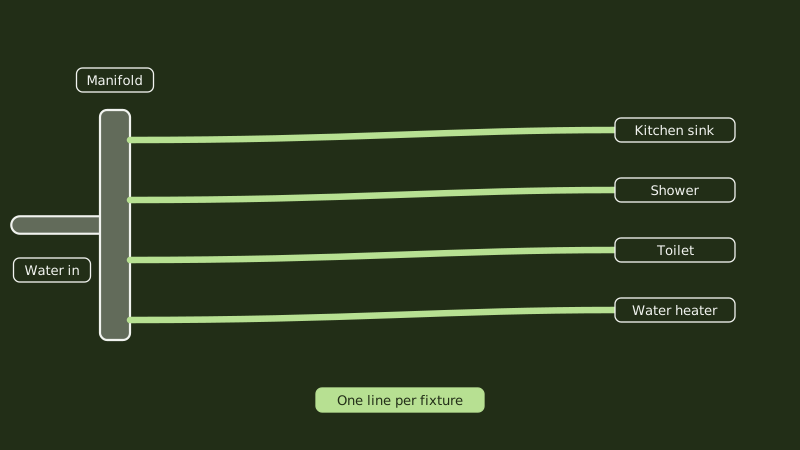
Repiping means removing the old supply lines, the pipes that carry pressurized water to every faucet, shower and appliance, and running new ones. For most Santa Ana houses today that new pipe is PEX, a flexible cross-linked polyethylene tubing. A typical 1,500 to 2,000 square foot home lands somewhere between $4,500 and $9,000 on published 2026 figures, and the visiting plumber puts the true figure in writing. Browse the other trades from the Santa Ana Plumbing Co home page.
Not sure you need this? Keep reading for the signs, the process and the arithmetic. If a plumber tells you a repipe is the only answer after one pinhole leak, get a second opinion and ask for a pipe sample.
Does a replumb mean opening up the walls?
Mostly not. Flexible PEX can be run across the attic or under the floor and dropped down inside existing walls, so you get small access holes, usually near fixtures, patched afterward. Some walls still need larger cuts, such as plaster behind tile, but a repipe seldom means gutting rooms.
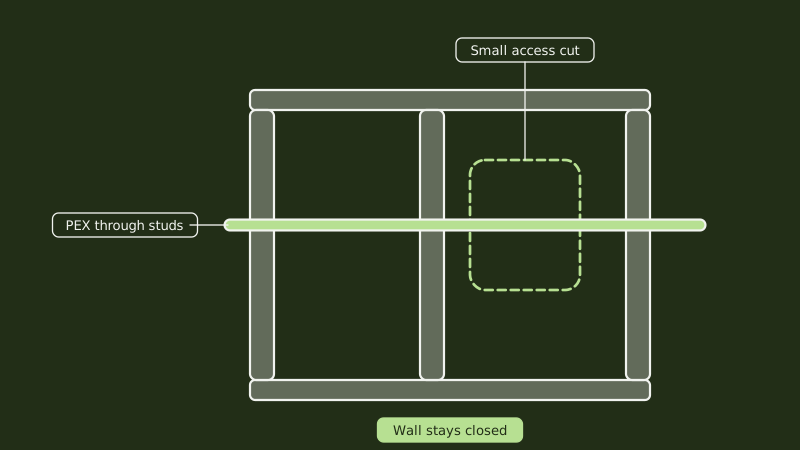
Think of it as threading, not demolition. In a typical single-story Santa Ana tract home, the crew works from the attic, fishes the new line down each wall cavity, and leaves the old pipe abandoned or removed from the places it can be reached. Homes with tile showers, stucco, or a second story demand more cuts, and the quote should say where.
Ask where the holes will go before you sign. A good quote lists the number of access points, who patches and paints them, and whether texture matching is in the price or left to you.
What is the timeline, and how many decades does new pipe give you?
A PEX repipe on a typical house runs about two to five working days, with the taps dry for stretches of each one, and contractor guides generally credit the finished pipe with four or five decades. Occupied houses, two stories and plaster walls add time. Slabs can add more.
Those figures come from contractor and cost guides, not from the pipe maker's standing promise, so ask for the manufacturer's warranty terms in writing. PEX does have known limits. It degrades in direct sunlight, so any exposed run outdoors needs cover, and fittings are a place where poor workmanship shows up first.
Before the work begins, plan for a few things:
- Expect dry taps for several hours a day, so fill a few jugs.
- Move what sits under sinks and along bedroom walls.
- Ask whether the permit covers a rough-in inspection before walls close. A repipe is plumbing work that cities usually inspect, and the City of Santa Ana's permits counter can confirm what applies to your address.
Could a handy owner repipe their own house?
Realistically, no. A whole-house repipe means dozens of connections that must hold pressure for decades, plus patching walls and coordinating inspections. California lets an owner do work on their own home under the owner-builder exemption, but permits and inspections still apply, and any help you hire must hold the right California contractor license.
The exemption comes from the Business and Professions Code and the state contractors board explains it for building departments. Read it before you buy a crimping tool. Most owners who try this save on labor and spend it back on mistakes: a leak inside a wall can ruin drywall and flooring before anyone notices.
Smaller jobs sit on a different footing. Replacing a single fixture supply line, a shut-off valve or a short run under a sink is a normal homeowner task. Replacing the main line from the meter or rerouting through walls is not a weekend job. For the order the work follows, there is a separate walkthrough of a repipe.
When does a repipe pay for itself?
It pays off when the old pipe is failing, or when an inspection, an insurer or a buyer flags it. Repiping seldom shows up as a line on an appraisal, but it removes a common objection. Some California insurers decline coverage on homes with polybutylene or galvanized lines, which makes the repipe a practical step, not a cosmetic one.
Weigh it against the alternative. Patching pinhole leaks one at a time can run to a few hundred dollars each, and ceiling and flooring damage from a hidden leak costs far more than the pipe. When leaks arrive every few months, a whole-house repipe usually wins.
On resale: contractors say a repipe cuts the price-reduction requests a buyer makes after inspection, but no one publishes a solid dollar figure for the gain, so treat the claim with care. What does devalue a house the most, in this context, is known failing pipe left in place. Polybutylene and heavily scaled galvanized steel both belong in that group.
How do you know your house needs a repipe?
Signs include low pressure at several fixtures, brown or rusty water at startup, repeated pinhole leaks, green stains at copper joints, and a plumbing system that is known to use polybutylene or galvanized steel. One leak alone is not proof. Several leaks in different places, or a pipe that looks corroded inside when cut open, is.
Polybutylene, a gray plastic pipe once common in North American homes, failed because chlorine and other oxidants in treated water degraded it, especially at fittings and bends. Galvanized steel rusts from within and narrows year by year. Both are reasons plumbers recommend replacement outright. Our pages on polybutylene pipe replacement and on galvanized pipe replacement go deeper on each.
Santa Ana tap water runs hard, near 250 parts per million by the city's own figure, so mineral scale builds up inside older steel and copper. That is one reason pipe in 1950s tract homes can look worse than its age suggests. Newer PEX is not affected by scale the way metal is.
Which pipe and layout make the best repipe?
For most owners the best route is PEX run from a central manifold or a branch layout, installed by a plumber who reroutes through the attic, with the permit pulled and a pressure test recorded. PEX costs less than copper and goes in faster. Copper still suits exposed runs and buyers who prefer metal.
PEX versus copper is a long conversation of its own. If you plan to go with PEX, the short question of PEX A versus PEX B comes up at every estimate.
Whatever pipe you pick, a few details separate a clean job from a messy one: pipe sleeves where PEX passes through framing, a pressure regulator and expansion tank if your house needs them, and a test held under pressure before the walls are patched.
Common questions
What will a 2,000 square foot house cost?
Published 2026 guides put PEX repipes at roughly $3.50 to $7 per square foot, so about $7,000 to $14,000 at the high end, while some Southern California quotes for a 2,000 square foot home sit between $5,900 and $8,600. Two stories and plaster walls raise it. These are guide figures only. The real price is whatever the written quote says.
And a 1,500 square foot house?
Guides spread wide, about $4,000 to $8,500, and a San Diego contractor lists $4,000 to $6,000 for two bathrooms at this size. Number of fixtures matters more than floor area. A guide is not a quote, so request one in writing. For more detail, see the price to repipe a house.
Does a slab foundation change the price?
Expect roughly a quarter to a half extra, per published guides, because the new lines usually run through the attic and walls instead of the slab. The work is slower, and walls need more access. If a slab leak is the trigger, compare a slab leak repair against a repipe before deciding.
Is there a low-cost way to do it?
Use PEX, keep the layout simple, and avoid replacing pipe that is still sound. Swapping just the failing section costs well under a full job, though old pipe stays behind. The lowest quote is rarely the lowest cost, so compare what each one covers, including permits, patching and testing.
In this section
- Repiping and pipe replacement
PEX-A or PEX-B for a Santa Ana repipe: how they differ in flexibility, fittings, flow and cost, why the letters are not a quality grade,…
- PEX repipe cost
PEX repipe cost for a Santa Ana house: published ranges for PEX, copper and polybutylene replacement, by bathrooms and size, with what…
- Repiping and pipe replacement
Replacing galvanized or polybutylene pipe in a Santa Ana home: signs it is time, repipe cost and timeline, permits, and why the old…
- Polybutylene pipe replacement
Gray plastic pipes from the late 1970s to 1990s?
- Repiping and pipe replacement
How a whole-house repipe works from first walk-through to final inspection, with PEX and copper compared, slab homes covered and a cost…
- Repiping and pipe replacement
PEX vs copper for a Santa Ana repipe: cost, flow, lifespan, hard water and permits compared, plus when each pipe makes sense for an older…
- Costs
What repiping a house costs in Santa Ana: PEX and copper ranges by bathroom count and square footage, slab homes, drywall extras and what…
Sources
- Wikipedia, Cross-linked polyethylene (PEX)
- Wikipedia, Polybutylene
- California Contractors State License Board, building official guide on owner-builder work
- City of Santa Ana, water quality FAQs
- Published repipe prices from several 2026 cost guides and California contractors (national and Southern California figures, read November 2026)
Last updated