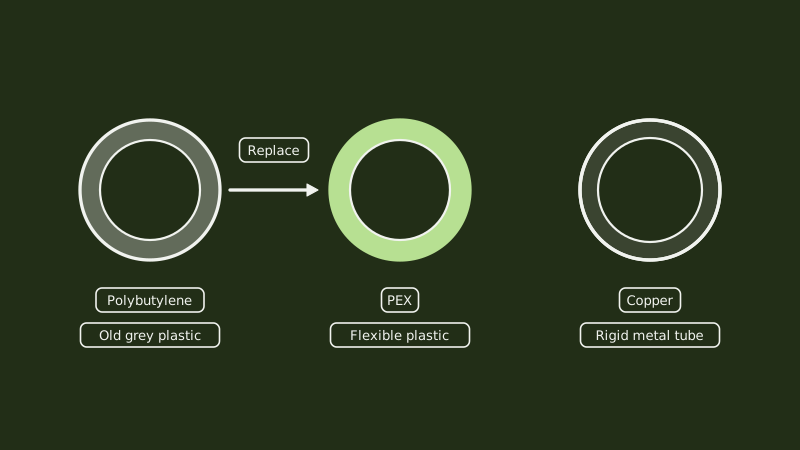
For an ordinary house, published PEX repipe prices span about four to ten thousand dollars, and copper costs more. Polybutylene, the gray plastic supply plumbing put into some houses between the late 1970s and the mid 1990s, sits in a similar band when swapped out: about $3,000 to $9,500 in guides. These numbers are drawn from national sources, and your own quote will differ. The method itself is on the main page about repiping a house with PEX.
What does a PEX repipe run?
Across 2026 guides the typical whole-house PEX job lands from four to ten thousand dollars, against a national average of about $7,500 for all materials combined. Per square foot, guides vary from about $2 to $7. A 1,500 square foot, two-bath home is often quoted at roughly $4,000 to $8,500, and more once drywall repair is included.
Labor drives the total, at around 70 percent in one guide. PEX is flexible and goes in faster than rigid pipe, with two to three days of work cited against five to seven for copper. The count of bathrooms moves the price more than floor area, and a third bathroom adds on the order of $1,000 to $2,500 in one guide. Slab foundations and tight access cost more. Local labor rates matter, so ask for quotes from Orange County plumbers rather than leaning on national averages.
| Home | PEX, published range | Copper, published range |
|---|---|---|
| Typical 1,500 sq ft, 2 baths | about $4,000 to $8,500 | about $7,000 to $15,000 |
| Larger house, 3 baths | higher, often $8,000 and up | often $12,000 and up |
| Mobile home | about $1,500 to $7,500 | about $3,000 to $12,000 |
What does a copper repipe cost?
Copper costs more than PEX, with published figures from about $6,000 up to $15,000 for an ordinary house and some guides quoting higher. One guide says copper adds 40 to 60 percent over PEX. Copper is slower to install, the pipe is pricier and fittings are soldered, but it can last for decades, and some owners choose it for that reason.
The gap on a typical 1,500 square foot home is often given as $3,000 to $5,000. Whether it pays off depends on how long you plan to stay and how you feel about plastic pipe. Santa Ana's tap water is hard, at roughly 250 parts per million according to the city, and the chemistry of local water affects how copper ages, so ask the plumber about the water and the pipe type. Our comparison page on PEX versus copper goes into the trade-offs.
What does polybutylene replacement cost, and why do it?
Replacing polybutylene with PEX is quoted at about $3,000 to $9,500 for an average single-family home. Millions of homes got polybutylene between about 1978 and the mid-1990s. Oxidants such as chlorine in city water attack it from within, leaving it brittle, and its plastic fittings crack too.
A class action, Cox v. Shell Oil Company, settled in 1995 with payments for replacement, but the claims window closed in 2009, so there is no fund to apply to. Homeowners with polybutylene today pay for their own repairs, and insurers often push for a replacement. The page on polybutylene replacement in Santa Ana explains how to identify it, and the page on the polybutylene replacement program covers what to ask. Gray, blue or black flexible plastic pipe near the water heater or meter is the thing to look for, and a plumber can confirm.
Does PEX flow as well as copper?
PEX is sized to match the outside of copper tube, but its walls are thicker, so its inside diameter is smaller. For 3/4 inch pipe, PEX measures about 0.68 inch inside against about 0.785 for copper Type L. PEX has a smoother interior, which partly offsets the smaller bore, and a Home Innovation Research Labs study found both deliver sufficient flow to fixtures in typical single-family homes at the same nominal size.
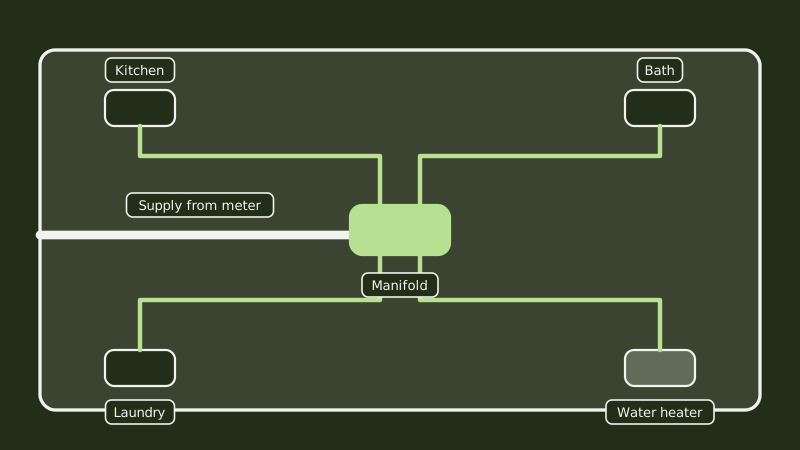
Some sizing guides suggest PEX may need one size larger than copper on long runs or high-demand fixtures, and plumbers often use a manifold layout with dedicated lines to each fixture. We did not verify a flow chart to publish here, so ask the plumber to size the lines for your fixtures and show the pressure at the farthest outlet. The page on which PEX type is better, A or B covers the types, and whether PEX or copper is right for a Santa Ana home takes the choice further.
What about mobile homes and smaller jobs?
Smaller systems make mobile home repipes cheaper, though the published figures disagree. One national guide shows an average near $1,000, while contractor guides list roughly $1,500 up to $4,000 for a single-wide in PEX and $3,500 to $7,500 for a double-wide. Lines often run through the floor, so repair of flooring may add cost.
The wide spread reflects different scopes. Some figures price a few fixtures and others the whole home. Ask whether a quote covers every supply line, the water heater connection, new shutoffs and the repair of any openings. For a house that needs only part of its plumbing changed, such as the lines behind one wall, a partial repipe costs less. A plumber can judge whether partial work is wise or whether failing pipe elsewhere means the whole house will follow.
What is included in a repipe price?
A repipe price should cover the pipe and fittings, labor, the permit, shutting off and restoring water, cutting and patching drywall, and cleanup. Many quotes leave out painting and finish carpentry. Ask whether the figure includes a new main shutoff, pressure regulator and water heater connections, and for how many hours a day the water will be off.
Rules apply. A repipe meets both of the state's triggers for a contractor license, which are a $1,000 labor-and-materials total and any permitted work, so look up the license number with the state contractor board. For Santa Ana houses the permit is issued by the City of Santa Ana Building Division, and other Orange County cities run their own offices. The plumber should say who applies and when an inspection happens. For how the work proceeds, see how they repipe a house, and pre-war and postwar houses are addressed in replacing plumbing in an old house.
Is repiping worth it?
Repiping is worth considering when pipes leak repeatedly, water is discolored or low in pressure, the plumbing is polybutylene or old galvanized, or an insurer requires it. Santa Ana's older stock, from the 1920s into the 1950s, often has galvanized or aging copper supply lines, and a house repiped once can be settled for decades. It is a major cost, so get more than one quote.
If only one section is failing, a repair may be enough, though repeated leaks usually point to the whole system. The page on the price to repipe a house lists the cost drivers in detail, and for leaks hidden below the floor, compare slab leak repair or repipe.
Common questions
What is the going price for a PEX repipe?
Published guides mostly say four to ten thousand dollars, with all materials averaging near $7,500 nationally. A two-bath house of 1,500 square feet is often quoted at about $4,500 up to $8,500. Bathrooms, access, foundation type, drywall and local labor all push it. Only the written quote, issued after a visit, gives the firm figure.
What about a two-bathroom house?
Take a two-bath house near 1,500 square feet: guides run about four to eight and a half thousand dollars in PEX, and seven to fifteen thousand in copper. Adding a bathroom adds about $1,000 to $2,500 in one guide. Drywall repair and permits may be in or out of the figure, so ask what the quote covers.
Which is cheaper to repipe with, PEX or copper?
PEX is cheaper, commonly by $3,000 to $5,000 on a typical home. It is faster to install and the pipe costs less. Copper lasts for decades and some owners prefer it. The right choice depends on budget, how long you will stay and what the plumber recommends for your water and house.
Can polybutylene be repaired instead of replaced?
Individual leaks can be repaired, but polybutylene can fail anywhere along its length and at its fittings, so repairs often only delay the problem. Many plumbers advise replacement, and insurers may too. A plumber can inspect the pipe and say whether yours looks sound. Moving to PEX is the usual replacement.
For a figure on your own house, begin at the quote page. The rest of our plumbing coverage is reached from the Santa Ana Plumbing Co home page.
Sources
- Published whole-house repipe prices from national cost guides and repipe contractors, checked November 2026
- Published mobile home replumbing prices from national cost guides, checked November 2026
- Home Innovation Research Labs (NAHB Research Center), Fixture Flow Rate Comparison, PEX and Copper
- City of Santa Ana Permits Counter
- City of Santa Ana, water quality FAQ (hardness about 250 ppm)
- California Contractors State License Board
Last updated