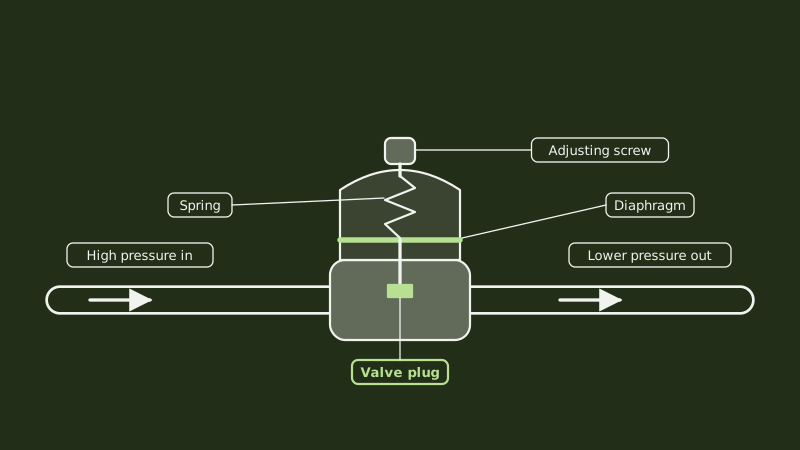
Budget about $200 to $650 for a swap, with most guides clustering between $300 and $500. The brass valve is the cheap piece, roughly $50 to $150. Labor and getting at it make up the remainder. If weak or noisy water brought you here, begin with the causes of weak pressure at home. To price your own situation, see how visits work on the home page and use the form at the foot of this page.
What will a plumber charge to put in a pressure regulator?
Published 2026 prices for a replacement, valve and labor together, mostly fall from $200 to $650, averaging close to $400. Adding a regulator where none exists, or reaching one on an awkward line, costs more. Every figure here is taken from cost guides, not from a quote on your property, so your own number will differ.
Published guides gave these breakdowns:
| Piece of the bill | Typical guide figure |
|---|---|
| The valve (regulator) | $50 to $150, premium models up to about $300 |
| Labor | about $150 to $450, taking one to three hours |
| Repairing a failing unit rather than replacing | about $75 to $200 |
| Large or pilot-operated valves | much higher, mostly commercial |
The guides disagree at the edges. One put easy basement access at $200 to $350, and a hard-access job at $350 to $500. Two outlier pages quoted far higher, up to about $1,600, and those looked less careful, so they are not used for the range on this page.
Whether you search for replacing or installing, the job is similar in practice. A failed regulator is swapped out. A house with none gets a new one near the main shutoff, and that means extra pipe work and a higher price.
Do Santa Ana prices run higher than the national guide?
We found no Santa Ana regulator price published anywhere we could verify, so the national range above is the honest guide. Labor in this region often runs at or over the national norm, so the middle or upper stretch of that range is plausible here. That is an expectation, not a measurement.
Where the regulator lives changes the job. Plenty of central Orange County houses, especially postwar tract homes on slabs, keep the regulator in a front-yard box, on the main line near the meter, or along the side wall. A bungalow built between the twenties and fifties may have none, or an ancient one. An accessible spot near the shutoff is the easy, cheaper case.
No honest single number exists. A local plumber checks the pressure, the valve and the access first, then writes the price. The visit is arranged by us, and no tool comes out until the price is agreed on paper.
What makes a regulator quote climb or fall?
Access, valve size, an expansion tank and whatever else turns up. A valve in a dry, open box beside the shutoff goes quickly. One tucked inside a tight wall, a seized main shutoff, or corroded steel pipe that has to come out adds time and parts.
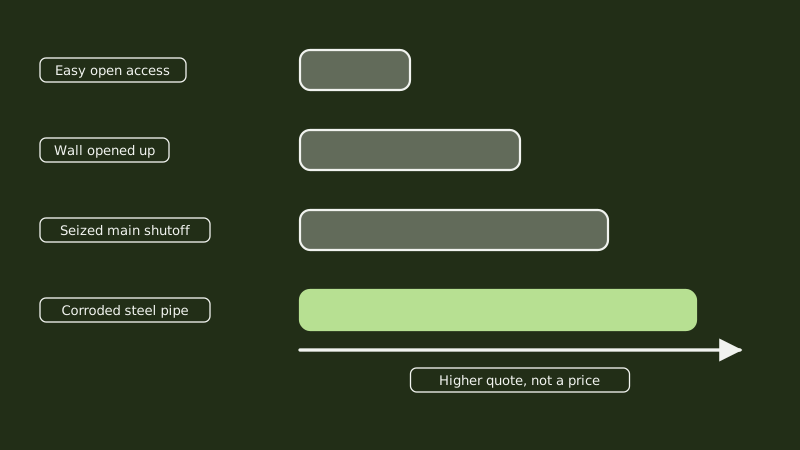
Factors that move a quote:
- Access. Open basement or garage versus a crawl space or a wall cut.
- Pipe size and material. Three-quarter-inch copper is standard, and larger service lines cost more to fit.
- Valve quality. A budget valve costs less up front. A better-rated one is typically more but tends to last longer.
- A thermal expansion tank. The 2025 California Plumbing Code asks for an approved one on the cold line after a regulator, so expect the plumber to look for one or add one, at extra cost.
- The main shutoff. If the shutoff valve is stuck or leaks, replacing it first adds a line to the quote.
- Permits. A permit may be needed. Ask whether it is included, and ask your city's Building and Safety office what applies.
- Scheduling. Out-of-hours visits are commonly priced higher.
Why bother? State plumbing code says a regulator must pull static pressure down to 80 psi or less whenever it exceeds that. Overpressure ages fixtures and appliances early and aggravates water hammer. The opposite complaint is covered in why water pressure is low, and the job itself in changing a pressure regulator.
Should I replace or repair the regulator?
Replacement is the usual answer. A regulator that lets pressure creep, hums or drifts is worn inside. Rebuild kits exist for some models, but the labor to reach the valve is identical, so many plumbers simply fit a new one. Ask to see the gauge reading before and after.
A threaded gauge on an outdoor spigot reads static pressure, and anything over about 80 psi crosses the code line. Weak flow can come from a failed regulator, a half-shut valve, clogged pipe or a problem out in the street, so the reading guides the decision. Pages that go deeper: where the regulator is located and water pressure regulator replacement.
Mention rusty water or crusty fixtures to the plumber, since grit and scale can clog the strainer inside a regulator. The city lists Santa Ana tap water at roughly 250 parts per million hardness, so a regulator here may need attention sooner than one in softer water. That is the plumber's call, not a rule.
How do I check a quote before I accept it?
Get the scope written down: valve brand and size, expansion tank, permit, access work and cleanup. Most regulator jobs come in under the $1,000 level at which California demands a contractor license, but ask for a license number anyway and search it on the CSLB site.
A short list to ask any plumber:
- Does the figure include valve, labor and permit, or only part?
- What pressure will it be set to, and can I watch the gauge?
- Is a tank needed, and is it inside the price?
- What if the main shutoff refuses to close?
- Is there a fee if I turn the quote down?
Judge quotes against an identical scope. A low number that skips the permit or the tank is not actually lower.
Common questions
How long does the swap take?
Published guides say one to three hours when the right valve is on the truck. A seized shutoff or buried pipe stretches that. Water stays off during the swap, so shower and cook beforehand. Those times are typical figures, not a commitment.
What do I ask before saying yes?
Find out exactly what the price covers: valve brand, expansion tank, permit, cleanup and any access work. Request the setting pressure plus the contractor's license number, then look that number up on the state board's site. Everything should be in writing first.
Must an adult be at the house?
Yes, an adult should be around to unlock gates, point out the yard box or main shutoff and agree the price after the plumber has looked. Water is shut off for some of the time the plumber is there. For an outdoor regulator, unlock gates, keep pets inside and clear a path to the box.
Can a bad regulator raise my water bill or damage appliances?
Too much pressure strains faucets, supply hoses and the water heater, wears washers sooner and worsens leaks. We cannot give a savings figure, because every home differs. Banging pipes or repeated leaks justify reading the static pressure with a gauge first.
Is a regulator required in Santa Ana homes?
The state plumbing code requires one once static pressure exceeds 80 psi, so it hinges on the pressure at your address, which a plumber reads with a gauge in minutes. Permit questions go to the City of Santa Ana Building and Safety division.
Sources
- Published water pressure regulator prices from several 2026 cost guides, checked November 2026
- California Plumbing Code section 608.2, excessive water pressure (2025 edition), as summarized by the International Association of Plumbing and Mechanical Officials
- California Contractors State License Board
Last updated