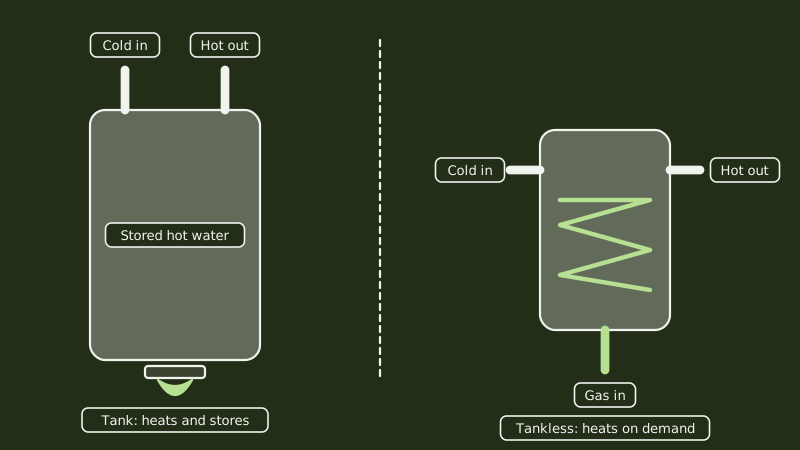
For most Santa Ana households that run a normal amount of hot water, a tank is the cheaper purchase and a tankless unit is the cheaper one to run. The deciding factors are how much hot water you draw per day, whether the gas pipe and venting can take a tankless, and how long you plan to stay. Each factor gets its own section below, and the main page on water heater repair and replacement covers the repair side.
How do a tank and a tankless water heater differ?
Picture a barrel versus a pipe. The tank type holds 40 to 50 gallons or more, keeps that volume warm day and night, and refills as you use it. The tankless type has no reservoir at all: when a hot tap opens, a burner or element heats the water as it flows through. That one difference explains the price, the running cost, the lifespan and the odd quirks of each type.
The practical effects show up in daily life. A tank can run short after back-to-back showers and then takes a while to recover. A tankless unit never runs out as such, but it has a ceiling on flow, so two showers and a dishwasher at once can overwhelm a small model. It also needs a little flow to switch on, which is why a barely open tap sometimes runs lukewarm.
Space differs too. A tank takes a floor footprint in a closet or garage. A tankless unit mounts on a wall and takes much less room.
Which costs more to buy and install?
Published national price guides show an installed gas tankless unit costing well over an installed gas tank. Much of that gap comes from the gas pipe and vent, not the unit. Treat these as a guide: a written local quote is the real price.
Where does the extra go? Most gas tankless models need a wider gas line than a tank, and guides list the upsizing as a few hundred dollars and more on a long run. Venting is another add: a tank flue generally cannot be reused, and new stainless or plastic venting costs extra. Add a condensate drain on condensing models and a permit.
Electric tankless units avoid gas work, but they pull a large electrical load, and guides report that a panel upgrade is common. That can erase any saving, so have the plumber and, if needed, an electrician check your panel before you commit. For what each install line costs in detail, see the tankless installation cost guide.
Which one costs less to run each year?
Federal energy figures give tankless a 24 to 34 percent efficiency edge in homes drawing 41 gallons or fewer per day, shrinking to 8 to 14 percent in homes drawing about 86. Cost guides turn that into a modest yearly saving on a gas bill, with your actual result swinging on household habits.
The gap shrinks as your usage climbs, and a DOE write-up on field results says the biggest savings come near 50 gallons a day. Big households, long showers or a recirculation pump all dilute the advantage.
For a rough check of your own, take your gas bill and estimate how much of it is water heating. Apply the percentages above and see whether the saving covers the extra install cost over the 15 to 20 years a tankless can run. Many homeowners find the answer is close, and the deciding factor is something else: running out of hot water, or wanting the closet space back.
How long does each type last?
Storage heaters typically serve 10 to 15 years in federal guidance, and tankless units 20 or more. Some cost guides quote a tighter 15 to 20 for tankless. The tank is shorter-lived because it holds water all day and the steel eventually corrodes, even with a working anode rod.
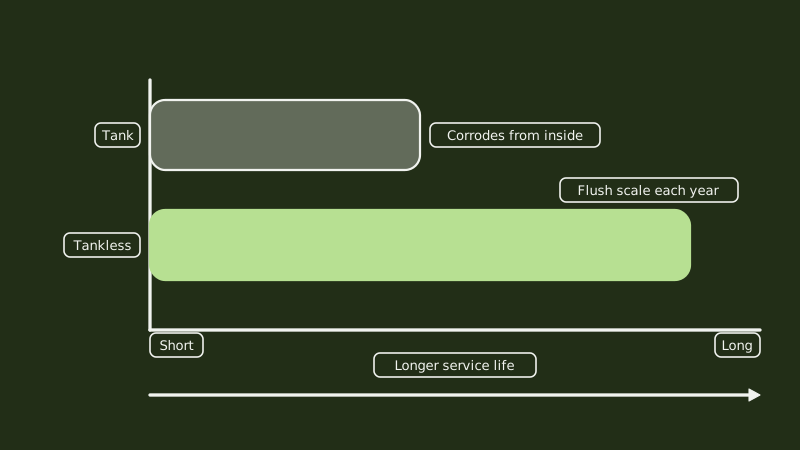
Water quality changes the picture in Santa Ana. The city's water quality FAQ puts hardness at roughly 250 parts per million, about 15 grains per gallon, and that scale builds up in both types. In a tank it sits on the bottom and wears the element or burner. In a tankless unit it coats the heat exchanger and can trigger error codes, so descaling at the intervals the maker sets matters. If you are comparing models, check what the maker says about hard water.
A tankless unit's repair costs also run higher per visit, because the parts are more specialized. A failed tankless heat exchanger can make replacement more sensible than repair. A tank that fails usually leaks, which ends the discussion.
Which fuel are you actually comparing?
Match the comparison to the fuel you have. Santa Ana homes are mostly piped for natural gas, so gas tank versus gas tankless is the usual contest. Electric tank versus electric tankless matters for homes without gas. Propane units exist for both, but they are far less common in a city with a gas network, so ask the plumber before assuming one is available.
Local rules shape the choice. A replacement in Santa Ana needs a city permit, and the unit has to be strapped to resist earthquake movement. For new single-family construction the 2025 California Energy Code (in effect since January 1, 2026) points to heat pump water heating. A direct swap in an existing house is judged under the alteration rules.
A heat pump heater is a third contender: a tank with a built-in heat pump, which needs open space and ventilation around it. Ask whether your closet or garage can host one.
What about a small mini-tank heater?
A mini tank is a small storage heater, often a few gallons, mounted under a sink or near a far bathroom to give fast hot water at one tap. It is not a replacement for a main heater. It makes sense where the main unit is a long pipe run away and you tire of waiting for hot water.
A mini tank costs far less than a whole-house unit and carries no gas or venting work if it is electric, though it needs a nearby outlet or circuit. A tankless unit can do the same job at one fixture, and a recirculation pump on a main heater is another way to cut the wait. The plumber can price all three for your layout.
Common questions
Can a tankless heater be repaired, or should it be replaced?
Usually repaired, if the fault is a sensor, igniter, flow valve or scale blockage. A failed heat exchanger is the expensive case, and on an older unit may tip the decision toward replacement. Ask for the repair price beside a replacement quote. Typical faults and prices are listed on the Santa Ana water heater repair page.
Is there a calculator for tank versus tankless?
Online calculators exist, but most guess your hot water use. A better method is to compare three things yourself: the extra installed cost of tankless, the yearly energy saving at your actual use, and how many years you will stay. Divide the first by the second to see the payback. The plumber's quote supplies the first number.
Did the rules change for water heaters around 2016?
No specific 2016 change has been checked for this page, so we will not describe one. The rules that bite now are the 2025 California Energy Code (effective January 1, 2026), the Santa Ana permit and the state strapping law. For efficiency standards on a specific replacement model, the plumber can confirm what applies.
Does a tankless heater fix low hot water pressure?
No. Tankless units limit flow, they do not add pressure. If hot water pressure is weak, the cause is more often a clogged fixture, scale in a pipe or a failing valve. Checks for that live in the guide to low hot water pressure, and whether no hot water is an emergency handles the other case.
To price either type for your house, send details through the quote page. Other plumbing topics are indexed from the Santa Ana Plumbing Co home page.
Sources
- U.S. Department of Energy, Energy Saver Guide 2022 (lifespan and energy savings by hot water use)
- U.S. Department of Energy, Building America, tankless gas water heater performance
- City of Santa Ana Permits Counter, project list (replace water heater: permit required)
- California Energy Commission, 2025 Energy Code update
- City of Santa Ana, water quality FAQ (hardness about 250 ppm)
- Published water heater prices from national cost guides, checked November 2026
Last updated