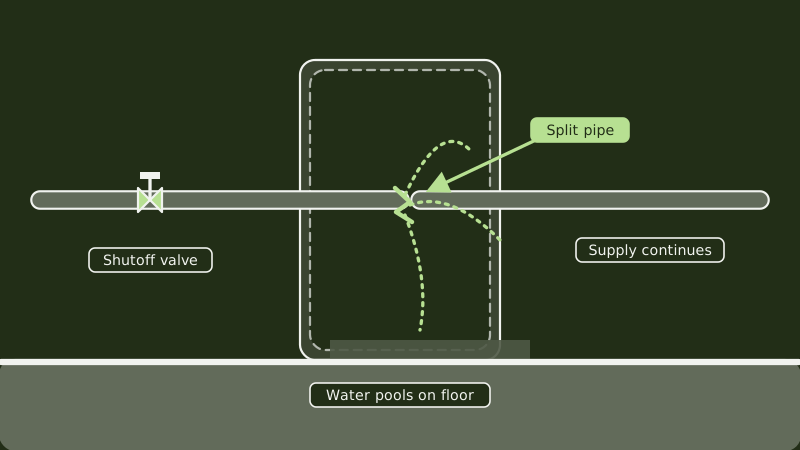
Spray in the hallway, a wet stain spreading across the ceiling, a tap that suddenly coughs and goes quiet while the floor turns dark: all of these mean a pipe has let go. Shut the main valve. After that, ring us, or describe the damage on the quote page, and a local plumber is dispatched to locate the break, make it safe and price the fix.
Phones here are answered on weekdays during business hours, 9am to 5pm. Outside that window, the shutoff steps below are the part that protects your floors, and they take two minutes. This page belongs to the wider burst pipe section of the site.
What comes first when a pipe lets go?
Turn the main water valve to fully closed, then open the lowest faucet in the house so the lines drain. Keep clear of standing water near outlets and the breaker panel. Photograph everything wet before you move it. Then call a plumber and your insurance company, in either order, but only after the water has stopped.
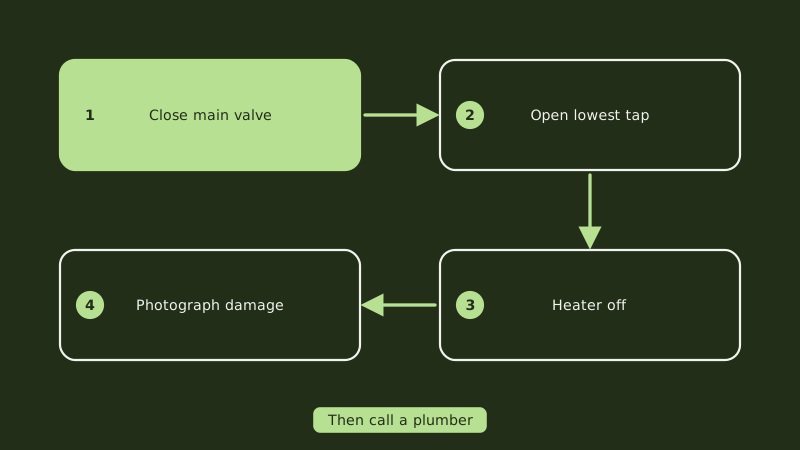
Finding the main: in many Santa Ana houses it sits on the outside wall facing the street, or in the garage, as a round wheel or a lever. The city meter, in a box at the curb, has its own valve, but Ready.gov says leave that one alone: it is stiff and needs a special key. If your house valve spins and nothing changes, it has failed, and that is a repair of its own.
Illinois Extension lists the same order: stop the supply, call a plumber, tell your insurer, and watch for shock near puddles. It also warns against thawing any pipe with a torch.
Small jobs while you wait:
- Lift rugs and electronics off the wet floor.
- Turn the heater off at its control if the broken line feeds it.
- Keep fans and wet vacs away from soaked outlets.
- Write down the time you first noticed the leak. Insurers ask.
A gas smell is a different emergency. Leave without touching switches and, from the sidewalk or a neighbor's porch, ring SoCalGas at 1-800-427-2200. If someone is hurt or in danger, 911 comes first.
Does a burst pipe have to be fixed today?
Treat it as a same-day call. Wet drywall and insulation hold water for days, and mold gets a foothold in that damp quickly. With the main closed the crisis becomes a scheduling matter, not a flood, but the house stays without water until the pipe is replaced or capped.
Rank the urgency by what the water touches. A jet inside a wall, a ceiling that sags, or a stream heading toward a panel: ring immediately. A weeping joint under a sink with the shutoff already closed can sit until a regular appointment slot. Not sure whether the pipe has really burst? Our page on spotting a burst behind a wall explains the clues behind walls, such as a warm floor patch, hissing, or a meter dial that creeps while every tap is off.
On arrival the plumber usually proves the shutoff holds, hunts the break (sometimes with acoustic or thermal leak detection gear when the pipe is buried in a wall), and states the repair and the cost. A short split in reach is often fixed on the spot. Opening framing, replacing a long old run, or going under concrete gets priced before anyone picks up a saw.
How much does an emergency plumber charge for a burst pipe?
Published cost guides put an emergency plumber visit around $215 to $655, with $377 turning up as an average total. Evening and weekend hourly rates commonly climb to between one and a half and three times the daytime figure. These are national figures from cost guides. The only number that counts for your house is the one the plumber writes down after looking.
Five things push the total up or down:
- The clock. Weeknight, weekend and holiday calls cost extra. Weekday daytime calls generally do not.
- Access. Under the kitchen sink, the plumber just reaches in. In a ceiling or the slab, demolition comes first.
- Material. Copper, galvanized steel, CPVC and PEX each fail differently and each needs its own parts.
- Scope. One failure sometimes shows that the whole run is tired, and a longer replacement beats a second burst next spring.
- Permit. Some repairs need one from the city.
For the repair figure on its own, minus the call-out, see burst pipe repair cost. Drying the room, new drywall and paint belong to other trades.
Is a burst pipe expensive to fix?
Not always. A split at an exposed supply line is a modest repair, while a break behind a finished wall or under a concrete floor lands in a different price class. The pipe is the cheap part. Labor, access, and everything the water ruined are where the money goes, and those are billed by different companies.
That split catches people out. The plumber stops the leak and replaces the failed section. A restoration company dries the structure. A general contractor or drywall crew rebuilds what was cut open. Insurance may treat a sudden burst differently from a slow seep, so read what insurers say about burst pipes and call your carrier before you pay for repairs you hope to claim.
A break under concrete is its own subject: see slab leak repair.
At what temperature do pipes burst?
Ice forms at 32 degrees F, and a pipe splits when the water inside freezes and swells. The risk sits in walls, attics, garages and anything outdoors, after several hours below freezing. Hose bibs and sprinkler lines go first, because nothing warms them and nothing insulates them.
Hard freezes are the exception on the Orange County coastal plain, which is why so many older homes here have bare pipe in the attic and uncovered spigots out front. When a rare cold night does arrive, those homes are the ones caught out. Illinois Extension suggests keeping the thermostat at 55 degrees or higher and leaving cabinet doors open under sinks on freezing nights.
Frozen but not yet split? Close the main, open the affected tap, and warm the pipe slowly with a hair dryer. Ring a plumber if you see a crack or damp. More on this in why pipes burst in winter and burst pipe prevention.
Can a pipe burst in hot weather?
Yes, and in Santa Ana most of them do. Heat alone is not the cause. Pressure spikes, water hammer, thermal expansion at the water heater, corroded steel, pinholed copper and brittle plastic are. A summer burst looks exactly like a winter one: a wet wall, a drop in pressure, the sound of running water.
Older galvanized lines rust from the inside out until a thin wall gives way. Copper can pit through. Plastic fittings and sun-baked irrigation lines crack with age. A pressure regulator that has failed can feed full street pressure into fixtures that were never meant to take it. The failures cluster at water heater connections, washing machine hoses, toilet supply lines and wherever pipe passes through framing.
Your response does not change with the season. Close the main, then call.
Where the burst happens: bathroom, apartment or yard?
Same first steps, different details. In a bathroom the culprit is usually a supply line or valve, and the small stop valve under the fixture may stop it without cutting water to the house. In an apartment, notify the landlord in writing. In the yard, a sprinkler line closes at its own valve.
Bathroom. Toilet supply lines, vanity stops and tub valves fail most. If water comes from inside the wall, go to the main.
Basement or crawl space. True basements are uncommon in Southern California. Where a crawl space exists, water can pool there unseen for days, so look under the house after any leak without an obvious source.
Apartment or condo. Tell the property manager the same day, ask where the building shutoff is, and photograph the damage. Shared risers and walls may be the building's problem, and the building's own plumber may do the work.
Sprinkler or yard line. Close the irrigation valve or the main. If a backflow device sits on that line, water districts require periodic testing of it. See backflow testing rates.
Can I repair a burst pipe myself, or does it need a contractor?
You can close valves and apply a temporary clamp. Permanent pipe replacement is contractor work. Since January 2025 the state contractor board allows work without a contractor only below $1,000 for labor plus materials together, and a job needing a building permit is never below the line.
The City of Santa Ana's Building and Safety Division handles plumbing permits inside the city. Its public pages say a permit comes before installing, altering, repairing or replacing a regulated plumbing system. Neighboring cities run their own building departments with their own counters. A plumber working locally knows which repairs trigger a permit; ask to see the permit number on the paperwork.
Gas piping is a hard stop for homeowners. If a water burst has damaged gas lines, leave that to SoCalGas and a plumber who works on gas.
Common questions
Once the main is shut, how long will a burst pipe still drip?
Only until the section above the break empties, usually a few minutes. Opening a tap at the lowest point speeds this. Leave the main closed until the damaged pipe is replaced. A clamp or wrap can hold briefly, yet it is a stopgap, and the failed section should be cut out and replaced.
How long does an emergency pipe repair run?
A split you can reach may be finished the same afternoon. Breaks inside walls, in old galvanized, or under concrete run longer, and may bring a permit and a second visit. Expect the plumber to name the scope and the cost before starting.
Which questions help when comparing burst pipe repair bids?
Ask what the price includes: the call-out, parts, permit, and any wall opening. Find out which business will turn up and whether it holds a California contractor license, then search the number on the state contractor board's site. Ask what happens if more damage turns up inside the wall.
Is a DIY patch ever acceptable?
For a few hours, yes. A rubber sleeve with a hose clamp or epoxy putty can slow a leak you can reach. It is a bridge to the real repair, not the repair. Our page on pinhole leaks in copper shows what a temporary fix can and cannot do.
What if the pipe goes after hours?
Shut the main, drain the lines and document the damage, then call when the phones open on a weekday, 9am to 5pm. We promise no response time. If gas is involved, step outside and ring SoCalGas on the number given earlier, or 911 if people are in danger.
More background is on the Santa Ana Plumbing Co home page, and the 24 hour plumber guide explains what after-hours work involves.
Sources
Last updated