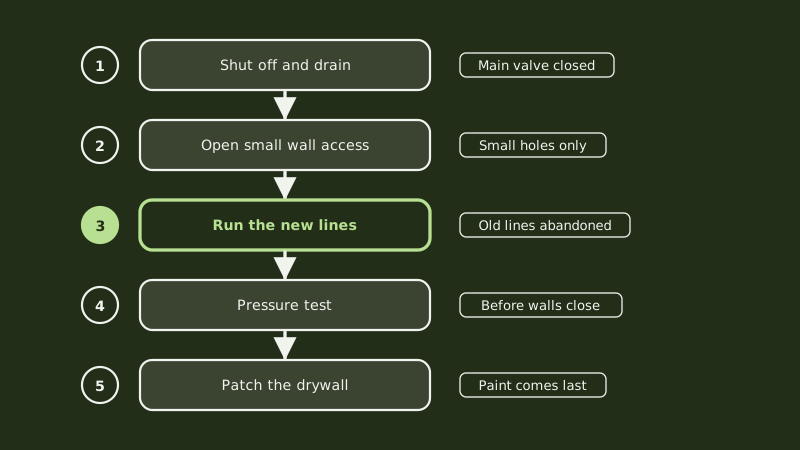
Picture a crew arriving at 7am: water shut off at the street valve, small access holes cut at a handful of spots, and new lines threaded by way of the attic or crawl space to every sink, shower, toilet and appliance. By the end of day two or three, the new lines are pressure tested, the city inspector has looked, and the water is back on. That is the short version. The long version follows, and it assumes a house in Santa Ana. The overview sits on our PEX repipe page, and the rest of our work is laid out on the home page.
What are the steps when a plumber repipes a house?
The job runs in a fixed order: a walk-through and written scope, a permit, shutoff of the water, new supply lines run to each fixture, a pressure test, a city inspection, then wall patching. Old pipe is often capped and left inside walls rather than pulled, which keeps the damage to drywall small.
In more detail:
- Walk-through. The plumber tallies fixtures, locates the water meter and shutoff, and inspects the attic, crawl space or slab. A written scope names the pipe type, the fixture count and what is included.
- Permit. A full repipe is permitted work under the California Plumbing Code. The plumbing contractor normally pulls it. See how to pull a plumbing permit for the process in general.
- Water off. Water is off for stretches of each working day. Ask for the schedule and plan for showers and cooking.
- Rough-in. New lines run to a manifold or a trunk-and-branch layout, then to every stub-out.
- Reconnection. Fixtures and the water heater are tied to the new lines.
- Pressure test. The system is filled and held at pressure so any weak joint shows itself.
- Inspection. The city inspector signs off. In Santa Ana that is the Building and Safety division, and each neighbouring city runs its own.
- Patching. Access holes get covered. Ask whether patching, texture and paint are included, because it varies.
What changes for a house built on a slab?
In plenty of slab houses the supply lines are buried in or under the concrete. Rather than breaking the floor, a plumber often abandons them and runs new tubing across the ceiling space, then down inside each wall. Slab homes are common in the postwar tract neighborhoods of central Orange County, and rerouting overhead avoids jackhammering the floor.
The usual approach for a slab house has three parts. First, the buried lines are capped and left where they lie. Second, a new line is run from the meter through the attic or an exterior wall. Third, each fixture gets a drop down a wall cavity, so expect more small openings than in a home with a crawl space below it. A slab leak that has already shown itself is a related question, and slab leak repair versus repipe weighs the two paths.
If the walls are plaster over lath, as in some pre-war homes near Floral Park, expect more careful cutting and extra patching cost. Older stucco exteriors can make exterior routing harder, so attic runs are favored.
What does a PEX repipe involve?
PEX, cross-linked polyethylene tubing, comes in flexible coils, so the plumber snakes it through walls and joins it with crimp or expansion fittings. It needs fewer fittings than rigid pipe and does not corrode. California approved PEX for potable water supply in its statewide plumbing code around 2009 to 2010, and the current code accepts it for supply lines only, not drains.
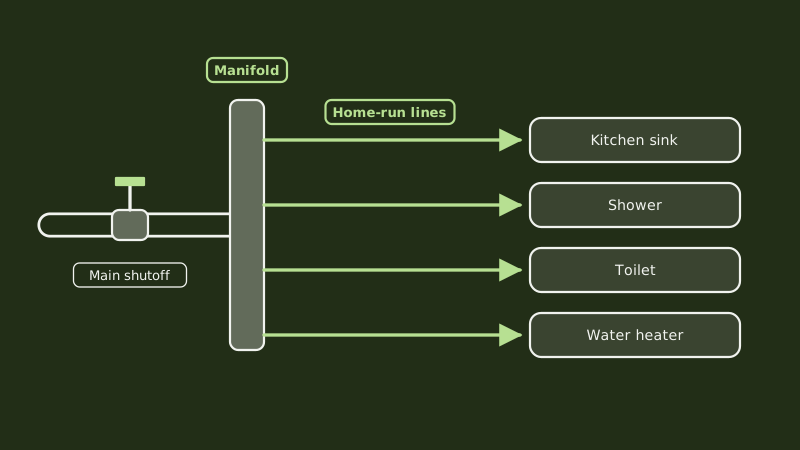
The flexibility is why PEX repipes are usually faster and cheaper than copper. Tubing bends around corners that rigid pipe needs elbows for, and one coil serves a long run. Color coding, a red-and-blue scheme for hot and cold, helps the inspector. PEX must be protected from sunlight and from contact with some chemicals, so exposed runs get sleeves or are kept inside the walls.
Two common questions: PEX A versus PEX B, covered in which PEX type is better, and PEX versus copper, covered in PEX versus copper. We arrange visits where the plumber explains which tubing and fittings go in your quote.
What does a copper repipe involve?
Copper repiping uses rigid tube cut to length and soldered at each joint. It is slower, needs more fittings and costs more in labor and material, and the joints are usually sweated with a torch. It holds up for decades, but older copper in hard water areas can develop pinhole leaks, and sources that report 30 to 50 years of life are mostly contractor pages.
The copper process matches the PEX steps up to the rough-in. After that, the plumber measures, cuts and solders every run, and each joint must be clean and fluxed. Some owners prefer copper for exposed runs, for a heat-heavy location such as near a flue, or because they like its record. Others choose it for resale conversations, though that value is a judgment call and not a measured fact.
Santa Ana's tap water is hard. The city reports around 250 parts per million, and many plumbers link hard water to scale in fittings and pinholes in thin copper, though the cause of any one leak needs a look at the pipe itself. For one failing spot, see fixing a pinhole copper leak.
How much does a whole-house repipe cost?
A published 2026 cost guide puts most whole-house repipes at roughly $4,000 to $15,000 nationwide, with copper toward the upper end. Treat that as a guide only: Southern California contractors publish wider ranges, and your written quote depends on size, access and patching.
| Factor | Effect on price |
|---|---|
| Number of fixtures and bathrooms | The biggest driver, since each adds drops and fittings |
| PEX versus copper | Copper commonly costs far more in labor and materials |
| Slab versus crawl space | Slab homes need more wall openings |
| Patching and paint included or not | Can add several thousand dollars if it is separate |
| Permit and inspection | A fee, plus the contractor's time |
| Pulling out old galvanized lines | Adds labor if lines must be removed |
For whole-home comparison, see the price to repipe a house, and older homes in particular are covered in plumbing replacement in an old house. Once a job reaches $1,000, the contractor must hold a California license, and a repipe calls for the plumbing classification. Request the license number and search it at the CSLB website, and settle the scope and price on paper first.
Is a repipe worth it, and when does an older home need one?
A repipe is worth considering when leaks keep appearing in more than one place, when water runs brown, or when pressure falls because old galvanized steel has narrowed inside. Pre-1960 homes with original galvanized lines are the typical candidates. One pinhole leak alone is usually repaired, not a reason to replace everything.
Signs that point toward a repipe rather than a patch:
- Rust-colored water that clears slowly after the tap runs.
- Low pressure at several fixtures even though the street pressure is fine.
- Repeated leaks in different sections within a few years.
- A known problem pipe material such as polybutylene, covered in polybutylene pipe replacement.
Many Santa Ana houses date to the 1920s through the mid-1950s, and original supply lines from that era were commonly galvanized steel or early copper. Those lines are near or past the age when plumbers expect trouble. That is a generalization, so a plumber should look at your actual pipe before suggesting anything. A permit is required either way, and SB 407 can require older fixtures to be replaced with water-saving ones when a permit is pulled on a single-family home dating to January 1994 or earlier, so ask how the city applies it.
Common questions
How long will a repipe take?
An average home often takes a few days, longer for big houses and slabs. Water usually goes off for stretches of each day, not the entire time. The plumber should put a schedule in the written scope. Treat the timing as typical, not a commitment.
Does a repipe need a city permit?
Yes. California treats a whole-house repipe as permitted plumbing work, followed by an inspection ahead of wall closure. The contractor normally pulls the permit. In Santa Ana the permit comes from the city's Building and Safety division, and other cities in central Orange County have their own offices.
May an owner repipe the house they live in?
California law lets owners do some work on their own home with a permit, but a whole-house repipe is large, and mistakes are expensive and hidden behind walls. Most people hire a plumbing contractor. Search the license at cslb.ca.gov, and make sure the written scope names the pipe and the permit.
Does a repipe damage my walls?
It opens them in spots. Plumbers cut small access holes in drywall, run the lines, and patch afterward. Old pipe is usually left in place. Plaster walls and tile need extra care. Ask in writing whether patching, texture and paint are included or priced separately.
Is PEX fine for drinking water lines?
PEX is approved for potable water in the California Plumbing Code when installed to code. Select pipe marked for potable use, protected from sunlight and from contact with certain chemicals. If you have concerns about a particular product, ask the plumber for its listing and check with the manufacturer.
Sources
Last updated