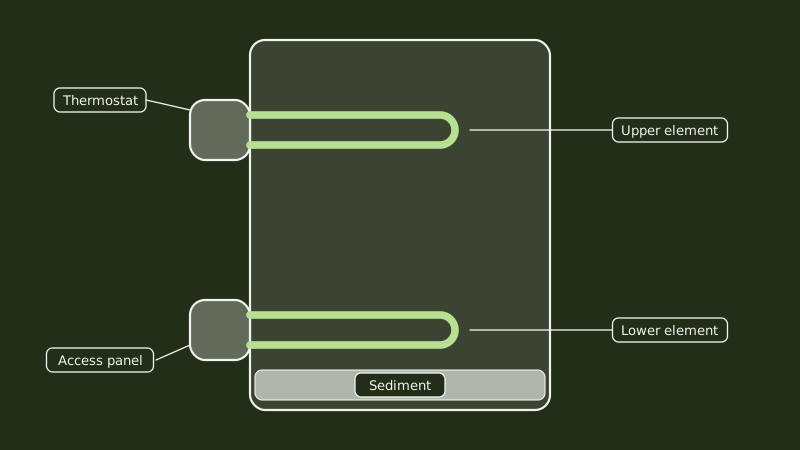
The heating element is the resistance coil inside an electric tank water heater, and it tends to be the first thing to give out. If your heater is gas, it has no elements, and the page on pilot light trouble is the one you want. For electric tanks, swapping an element is a modest repair on a sound tank. If the tank is old or leaking, a new unit is the better buy, and our tankless water heater installation page shows the alternative to another tank.
Which symptoms point to a burnt-out element?
The classic sign is a shower that goes cold quickly or never gets properly hot. Others are lukewarm water, a tripped breaker, water that is hot at first and then turns cold, or no heat at all. These symptoms also fit a bad thermostat or a tripped high-limit switch, so a test is needed before buying parts.
Most electric tanks hold a pair of elements, an upper and a lower, each wired to its own thermostat. What you notice depends on which one died:
- Upper element dead. Often no hot water at all, because the upper element heats first.
- Lower element dead. A little hot water that fades within minutes.
- Short circuit to the tank. A tripping breaker as soon as the heater tries to run.
If the problem is that the heater is on but nothing comes out hot, our page on water heater on but no hot water lists the other suspects, and the whole-house no hot water page takes a wider view.
Is it only electric heaters that have elements?
Yes. Gas heaters fire a burner beneath the tank and have a burner, a thermocouple and a gas control valve instead of an element. Elements belong to electric resistance tanks, and heat pump water heaters use them as backup. Check the label on the tank to see whether yours runs on gas or electricity.
Many Southern California houses have gas water heaters, so an electric tank is more likely in an apartment, a condo, an addition or a home with no gas service. Gas around a gas heater is a different matter, and not one to investigate. Walk out, then phone SoCalGas, 1-800-427-2200, from the street. Ring 911 if the situation feels dangerous.
How is a water heater element tested?
An element is tested for continuity with a multimeter after the power is off and confirmed dead. A good element reads a low resistance, while an open circuit means it has burned out. A reading to ground, meaning a connection between the element and the tank, means the element has shorted.
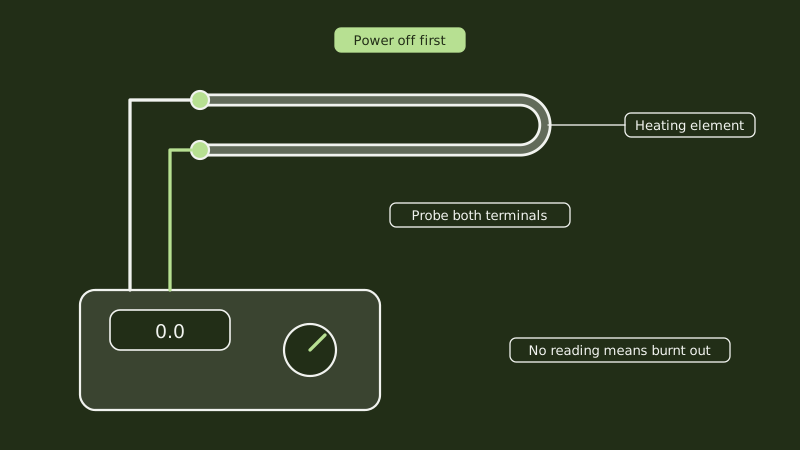
This is where safety matters most. An electric water heater runs on 240 volts, and a mistake can be fatal. The sequence a careful person follows is:
- Switch the heater's breaker off at the panel.
- Remove the access panel and insulation, and confirm with a non-contact tester that nothing is live.
- Disconnect the wires from one element, and test it with the meter.
- Never energize the heater with the tank empty or the element exposed, since an element run in air burns out in moments.
Unsure how a multimeter works, or unsure the power is truly off? Hand it to a plumber or an electrician. Water and 240 volts is not a place for guessing.
Why do elements die early in hard water?
It coats them. Santa Ana water is hard, about 250 parts per million by the city's figure, and heated water drops calcium onto the hottest surface, which is the element. A scaled element works harder, insulates itself and burns out sooner. Tank temperatures above about 140 degrees Fahrenheit speed the crusting.
Scale also drifts down and piles around the lower element, sometimes burying it. That is why a worn element often comes out of the tank wearing a thick white sleeve, and why flushing a tank yearly, as the maker advises, helps. Removing hard water scale explains the descaling side. A softener will slow it, and our anode rod replacement page covers another way to protect an aging tank.
Can I replace the element myself?
A handy person can, but the job is not trivial. The steps are to turn off the power, shut off the cold supply, drain the tank to below the element, unscrew the old element with an element wrench, fit a new one with the right wattage and voltage, refill the tank completely, then restore power. It is not a job to rush.
Match the new element to the old one in voltage, wattage, and thread or flange style. Fill the tank and bleed air from a hot tap before the power goes back on, because heating a dry element ruins it. Seized elements and a corroded tank opening are common in hard water areas. If the element will not budge, or you see rust around the opening, the tank may be nearly spent.
Replacing an element is generally a repair. Replacing the water heater itself needs a plumbing permit in Santa Ana, issued by the city's Building and Safety division, and seismic strapping has to be in place. The city notes that a water heater replacement is eligible for its express permit process. To weigh repair against replacement, use the water heater replacement price guide together with the notes on water heater lifespan.
When is a new element not the answer?
A leaking tank, an aged heater or water with an odd smell all say the element is not the problem. Water pooling around the tank means the tank shell is failing, and shells cannot be patched. An old heater may fail again soon after you pay for parts.
A leaking tank has its own page, water heater leak help, and a swap in water heater replacement visits. Leave the relief valve alone, since it is the tank's safety device. Torn between a new tank and a tankless unit? Tank vs tankless lays out the tradeoffs. To have someone local look at yours, send a price request. Browse our other services from the Santa Ana Plumbing Co home page.
Common questions
How many years can I expect from an element?
No fixed number applies. Elements often serve for years, and hard water, a high thermostat setting and sediment cut that short. A dead element in an otherwise young heater is a sensible repair. When the tank is already well past ten, many owners prefer a new heater, so ask what the plumber finds inside.
What goes in a quote for an element swap?
Check that it covers testing both thermostats and the second element, and a look at the tank's condition. Request the license number the contractor works under, which the state board publishes for lookup. A tank in poor shape may make a new heater the better use of money.
Who needs to be around while the heater is opened up?
Someone over eighteen should be home to unlock whichever garage, closet or attic holds the heater and to show where the breaker is. The work often takes part of a visit, and you will be without hot water while the tank drains and refills.
Can a failing element raise my electric bill?
Sometimes. A shorted element, a stuck thermostat or a leaking tank can make the heater run more. A dead element does the opposite, as it stops heating. See our guide on whether a broken water heater can cause a high electric bill.
Is it safe to keep using a heater with a bad element?
If the heater is only producing lukewarm water, it is not a hazard by itself. But a tripping breaker, a burning smell, water around the tank or a hissing relief valve calls for turning it off and getting it checked. Do not bypass or plug the relief valve.
Sources
Last updated