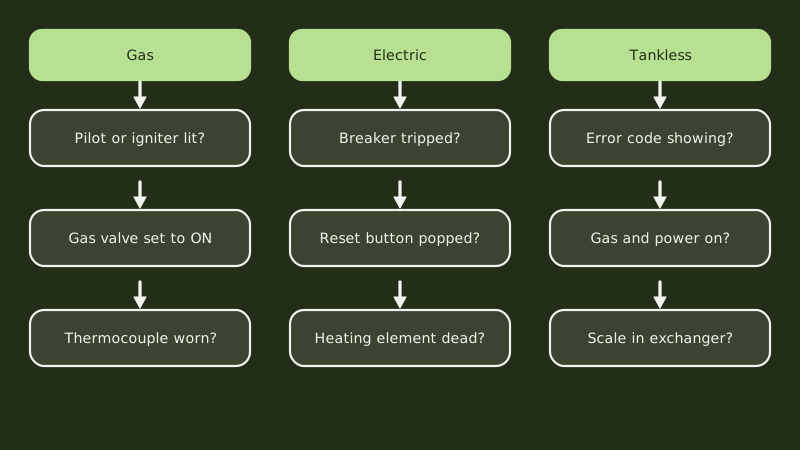
A heater that hums, clicks or shows a light but delivers only cold water has usually lost its heat source, not its power. On a gas unit, that points to the pilot, the thermocouple or the gas control. On an electric unit, the culprits are the heating elements, a thermostat or a tripped high-limit switch. On a tankless model it is often an ignition or flow fault. This is part of our coverage of water heaters in Santa Ana, and what follows tracks the order in which a trade professional would test things.
Why is my water heater on but giving no hot water?
Because something between the controls and the water has failed. Gas heaters most often lose the pilot flame or a thermocouple that tells the gas valve a flame exists. Electric heaters usually have a burned-out element or a thermostat that no longer calls for heat. Mineral sediment, a snapped dip tube or heavy demand on a small tank can leave the taps cold too.
A useful first question is what exactly runs cold. Cold at every hot tap, always, points to the heater. Hot water that lasts two minutes then turns cold points to a tank that is not recovering, which could be a lower element, a sediment-choked burner or an undersized tank. Cold at only one faucet or shower belongs to the fixture; two pages deal with those: a cold shower and a cold kitchen tap.
Some searches describe "hot water but no heating." A water heater does not heat the rooms in most Orange County houses, which use a furnace or heat pump. If the hot tap works while the rooms stay cold, the heater is blameless, and the page on hot water without central heating covers that.
What should I check first on a gas water heater?
Look at the pilot window and the control knob. A dead pilot means no burning gas. Relight it only by the steps printed on the heater's own label. If the pilot lights but dies when you release the knob, the thermocouple is probably worn. If the burner lights and the water stays cold, check the temperature dial is not on vacation or pilot.
Do this in order: confirm gas to the house (other gas appliances work), check the dial setting, peek at the burner flame through the viewing port for a steady blue color, and make sure the combustion air and the vent are not blocked. A yellow, lazy flame or a soot streak above the heater is a warning sign. Stop there and bring in a plumber.
The moment you smell gas, it becomes an emergency. Everyone goes outside, and from the yard you ring SoCalGas at 1-800-427-2200. If anyone is in danger, or the utility is unreachable, 911 is the next call. No lighters, no switches.
Relighting a pilot is something the label instructs owners to do. Replacing a control valve or touching gas piping is not. California makes gas piping contractor work, and the write-ups on relighting and repairing a pilot and gas water heater repair mark where that line falls.
What should I check first on an electric water heater?
Start at the electrical panel. A tripped breaker is the commonest cause of an electric heater with no hot water. Next, find the high-limit reset, a red button on the upper thermostat behind the access panel. If the breaker keeps tripping or the reset pops again, a short in an element or the thermostat is likely. Switch the power off before opening any panel.
The tank has two elements, upper and lower, and a thermostat for each. When the upper one fails, you get no hot water at all. When only the lower one fails, you get a small amount of hot water that runs out fast. A multimeter test tells you which. Replacement elements are inexpensive parts, but working inside an electrical enclosure means switching off the breaker and confirming the power is dead, so plenty of owners hand it to a plumber. The page on replacing a water heater element shows what the repair involves.
The reset button and the thermostat protect against overheating. If the water is scalding at some times and cold at others, stop using the heater and call someone. A dial setting around 120 degrees Fahrenheit is commonly suggested to limit scalding.
What if the unit is a tankless heater?
A tankless heater can shut itself down for several reasons: low gas or water flow, a clogged inlet filter, an exhaust blockage, scale inside the heat exchanger, or a power fault. Read any error code on the display and look it up in the manual. Then check that other gas appliances work, the filter is clean, and the faucet is open enough to trigger the flow sensor.
Hard-water scale is a frequent cause, and many manufacturers recommend periodic descaling, with the interval depending on water hardness. Santa Ana's hardness is something I have not verified from the city's current report, so ask the plumber about it. Do not repeatedly reset a unit that shows an exhaust or ignition code. Specific brand pages exist, such as Rinnai tankless repair, and general buying guidance is on tank versus tankless.
Could it be the tank, a leak or sediment?
Yes. Sediment from years of minerals settles at the bottom, insulates the heat source and can make a tank noisy, slow and weak. A cracked dip tube lets incoming cold water mix near the top, so output turns lukewarm. A tank that leaks or rusts through needs replacement, not repair.
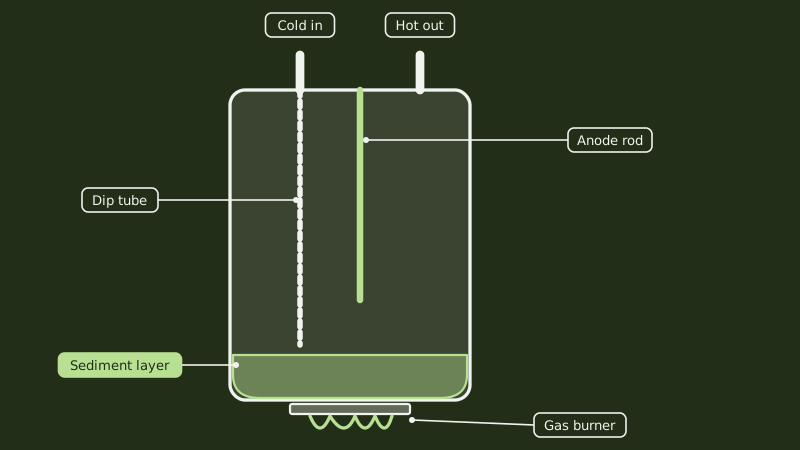
Look around the base for water or rust streaks. Warm or lukewarm water that fades quickly in a heater over ten years old is a classic sign of age. An old heater that fails in a new way every few months can rack up more in repairs than a replacement costs; the cost context is in water heater replacement cost, and for the leaking case see water heater leak help.
What will the repair cost?
As a guide from national price listings read in November 2026, most repairs fall between about $150 and $700. A thermocouple or pilot fix is commonly lower, and a full tank replacement runs about $875 to $1,800. The written quote has the final word.
Rough guide, not a quote:
| Repair | Typical range |
|---|---|
| Electric element or thermostat | Set by the written quote |
| Gas pilot or thermocouple, then gas control | about $100 to $250, then about $300 to $550 |
| Tank replacement | about $875 to $1,800 |
Same-day or after-hours visits add to these. Wondering how urgent it is? Our page asking whether no hot water is an emergency helps you judge, and why a house has no hot water widens the checklist.
Once a repair goes past what the label allows, hire someone holding a California contractor license and check that number on the state license board first.
Common questions
What leaves water lukewarm even though the heater runs?
Lukewarm output usually means one element is dead on an electric unit, the thermostat is set low, a dip tube has broken, or sediment is coating the heat source. On a gas unit a dirty burner or a thermostat set too low does the same. A mixing valve or a crossover between hot and cold lines can also dilute the hot water.
Can I fix a no-hot-water problem without a plumber?
The first checks are within an owner's reach: breaker, reset button, dial setting, and relighting a pilot per the label. Gas piping, a gas control valve or wiring inside the unit belongs to a professional. Scalding water or a gas odor means stop and get help.
How long until the hot water is back?
Small jobs such as an element, thermostat or thermocouple commonly wrap up in an hour or two when the part is on hand. Flushing sediment adds time, and a tank replacement can take half a day. Tankless repairs depend on the error and the part. Get a time estimate along with the quote.
Does a heater need a permit for these repairs?
Small repairs such as an element or thermostat usually do not, but replacing the heater, changing gas piping or venting generally does. Rules differ between cities, and Santa Ana's Building and Safety division handles permits within the city. The contractor doing the work normally applies for the permit; what a water heater permit involves explains it.
The rest of our guides start from plumber santa ana.
Sources
Last updated