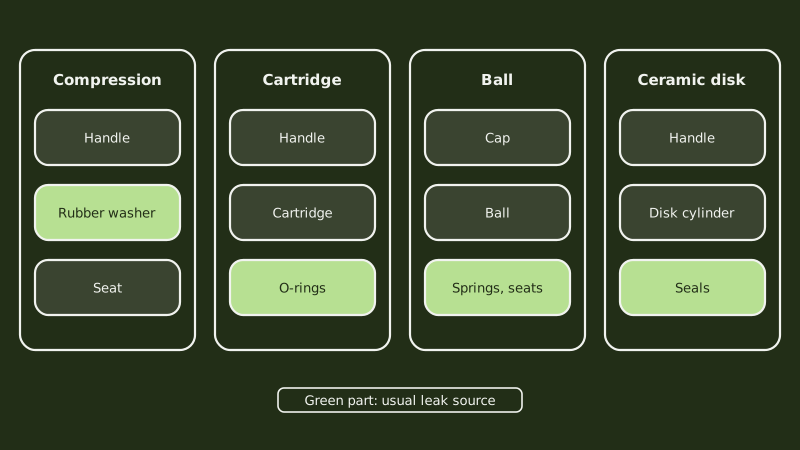
You fix a leaky faucet by turning off the water, taking the faucet apart, and replacing the part that wears: a rubber washer on older two-handle faucets, a cartridge on most single-handle ones, or the seals around a ceramic disc. The whole job is usually under an hour. Working under a kitchen sink anyway for a garbage disposal installation? Do both jobs in the same sitting.
How do you know which kind of faucet you have?
Start with the handles. A pair that spin round and round before they stop marks a compression faucet, the oldest design. One lever that swings side to side and up and down is a cartridge, ball or ceramic disc faucet. A dome cap under a single lever points to a ball faucet. A ceramic disc faucet feels smooth and short-throw.
Look for a model number stamped on the body or printed on the box if you still have it. Manufacturers publish exploded diagrams by model, and the right part is easy to order once you know it. If the faucet has no markings, take the old part to a plumbing supply counter and match it by eye.
The type decides the part that fails. Compression faucets wear washers and O-rings. Cartridge faucets wear cartridge seals. Ball faucets wear springs and seats. Ceramic disc faucets rarely fail in the disc, and the rubber inlet seals around it are the usual culprit.
How do you fix a dripping faucet step by step?
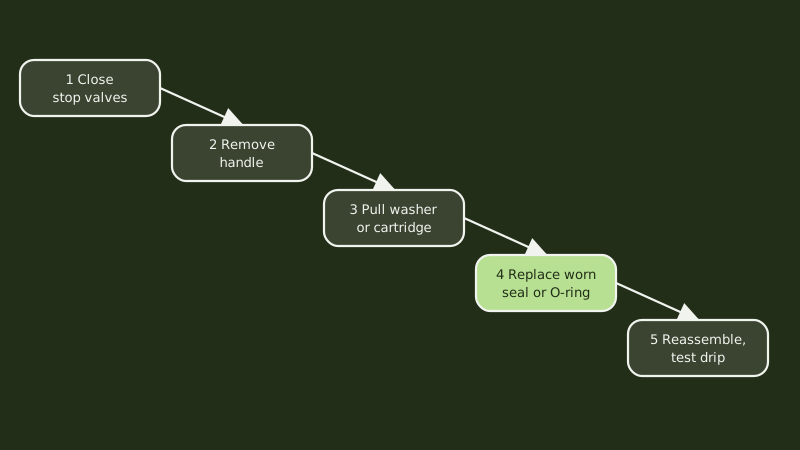
Begin under the sink: close both supply valves clockwise until snug, then let the faucet run dry. Stuff a rag in the drain so a dropped screw does not vanish. Next lift off the handle, pull out the tired washer, O-ring or cartridge, press in the matching part and rebuild in reverse. A phone photo at each stage makes rebuilding easy.
A few details save trouble:
- If the sink has no shutoff valves, close the main valve to the house, and expect to deal with the missing valves next.
- Coat new O-rings with plumber's grease so they seat without tearing.
- On a compression faucet, run a fingertip around the valve seat. A rough seat will chew up a new washer, so smooth it with a seat dressing tool or replace it.
- On a ceramic disc faucet, restore the water slowly. A sudden surge can crack a disc.
- Replacement parts are commonly in the $5 to $15 range at a hardware store, according to published repair guides.
Santa Ana tap water is hard, with the city's water quality FAQ putting it at roughly 250 parts per million, about 15 grains per gallon. Scale often sits on old parts. Soaking removable metal pieces in white vinegar can clear deposits, and sometimes that alone stops a slow drip.
Why is the faucet leaking in the first place?
A faucet leaks because a seal has worn or a part has scale on it. Worn washers and gaskets top the EPA's list of causes. Its estimate for a drip a second: upwards of 3,000 gallons every year, roughly 180 showers' worth. That alone justifies a repair.
Location is the clue. Water from the spout mouth means the washer, seat or cartridge has given up. Moisture at the base or beneath the handle suggests an O-ring. A wet cabinet floor may come from the supply lines or shutoffs instead, so wipe the cabinet dry with a paper towel and watch where it gets damp first. For kitchens and bathroom basins there is a sink-specific piece on fixing a leaky sink faucet, and another on the pipe under the sink.
If faucets all over the house start dripping around the same time, suspect pressure. High pressure wears seals fast, and the water pressure regulator is the part that holds it in check.
How do you fix a leaky bathtub or shower faucet?
Tub and shower valves hide behind the wall, but the repair follows the same logic. Shut the water, pop off the handle and trim plate, and draw out the cartridge or stem. A cartridge usually pulls straight out or after removing a retaining clip. Match the new one by model number, grease it, and refit. Cartridges and stems on these valves are often one part.
If you have no access panel and no shutoff for the bathroom, the main valve is your shutoff. A tub spout that drips when the shower runs is a different issue: the diverter inside the spout is worn, and replacing the spout often solves it. Valve layouts differ, so use the separate write-ups for a tub faucet and a shower faucet.
When the valve is soldered into a copper line inside the wall, or the wall tile has to be opened, that is plumber work. The same goes for a valve whose trim no longer matches any current cartridge.
What if the outdoor spigot or hose bib is the one leaking?
A wet handle while the spigot is open usually blames the packing nut or stem washer. With the water off, snug the packing nut about a quarter turn. Still weeping? Renew the packing or washer. A drip at the spout when the faucet is shut points to a failed washer or seat. Most of these are quick repairs.
Outdoor faucets differ from indoor ones in one way. Many carry a vacuum breaker, a small cap-like device at the spout that stops garden hose water siphoning back into the house supply. Leave it on. If water escapes near it, look at the stem and packing first. Santa Ana does not see the hard freezes that burst hose bibs in cold states, but a spigot that leaks inside the wall is the case to hand over. A pinhole in the line behind the wall needs a pipe repair, not a washer. Two related reads: outdoor faucet repair and leaks from plastic pipe.
Which leaks are a plumber's job?
Phone for a plumber when a shutoff valve refuses to close, the faucet body has corroded, parts no longer exist, or damp appears in a wall or below a floor. None of those is a washer job. The same applies if you have replaced the part and the faucet still leaks, because the seat or body is probably damaged.
Replacing a whole faucet is the common answer in that case. A new faucet costs more than parts but ends repeat repairs, and a plumber fits it with new supply lines and shutoffs. Hand over the job early if the supply valves are old and seized, because forcing them can start a bigger leak.
If water is coming from more than the faucet, such as a ceiling stain below a bathroom, treat it as a pipe leak and shut off the main. A stained or dripping ceiling has its own first-steps page: water leak in the ceiling.
The quote page takes a description of the faucet; a local plumber then visits, puts the repair or replacement price in writing, and does the work.
Common questions
What does a dripping faucet cost in wasted water?
EPA WaterSense reckons a single drip each second adds up to more than 3,000 gallons annually. Faster drips cost more. To test the whole house, write down the meter reading, leave every tap alone for two hours, then look again: movement means a leak somewhere.
Is it safe to work on a faucet with the water on?
No. A pressurized line can flood the cabinet in seconds. Close the pair of valves beneath the sink, or the house main when there are none, then open the faucet to bleed pressure before loosening anything. A plugged drain catches small parts.
The faucet still drips after a new washer. Why?
Usually the valve seat is rough or pitted, and it cuts the new washer. Smooth it with a seat dressing tool or replace it. Other causes include the wrong washer size, scale on the seat, or a cracked faucet body. If a second repair fails, replacing the faucet is often cheaper than a third attempt.
What about a Delta faucet?
Delta sells several designs, so identify yours before buying parts. Many use a replaceable cartridge or a ball assembly. The model number is stamped on the body or printed on packaging and check Delta's published parts list for it. The sequence is the one above, and the maker's diagram for your model overrides any general advice.
The rest of our plumbing coverage starts from the Santa Ana Plumbing Co home page.
Sources
- U.S. EPA WaterSense, Fix a Leak Week (drip rate, worn washers and gaskets, meter check)
- City of Santa Ana, water quality FAQ (hardness about 250 ppm)
- Step-by-step faucet repair guides from plumbing publishers and retailers, checked November 2026
Last updated