Shut the little valves in the cabinet, take the faucet apart, replace the worn washer, O-ring or cartridge, and put it back together. That is the whole repair for a dripping spout. What changes is the part, which depends on the faucet type. If the leak is the fixture's body or the pipes below, the job moves toward a plumber, as covered with the other fixtures on our faucets, sinks and disposals page.
What type of faucet is on my sink?
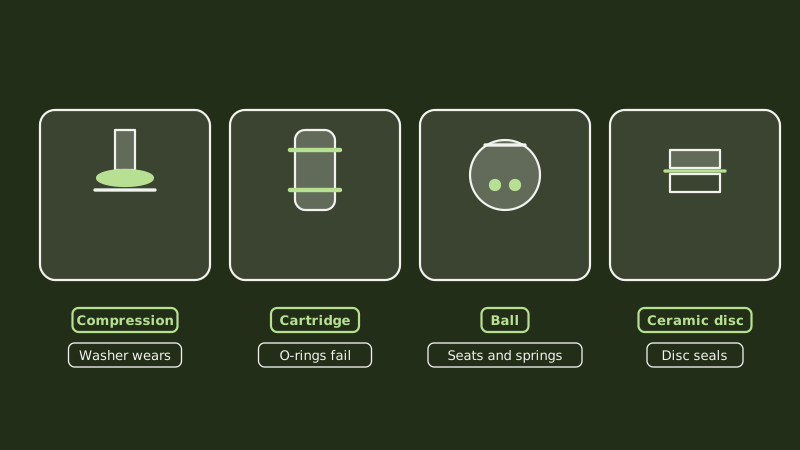
Start with the handles. Two handles, each with a rubber washer on its stem, suggest a compression faucet, the oldest design. A single lever with a rounded cap is often a ball faucet. A single or double handle that lifts or turns smoothly usually hides a cartridge. A wide cylinder with ceramic discs inside is the disc type.
Why it matters: the part that wears is different in each. A compression faucet leaks from a washer or seat. A cartridge faucet leaks from the cartridge itself or its rubber rings. A ball faucet has seats and springs. A ceramic disc faucet leaks from seals under the disc assembly, and rarely at all. Find the brand name on the body, since it lets you buy the matching part by model number.
Where exactly is the water coming from?
The spot where water shows tells you the part. Drips from the spout while the faucet is closed point to a washer, cartridge, ball seat or disc seal. Water around the handle means a worn stem ring or loose packing nut. Water pooling where the spout meets the body suggests body O-rings.
Dry the sink area, and watch for a minute with a paper towel under the handle. If the leak is under the sink, it may not be the faucet at all: it could be the supply lines, the drain or the shutoff valves, and the page on leaks beneath the basin walks through those. A faucet that drips only when hot is on usually has a failed hot-side cartridge or washer.
What are the steps to repair a drip?
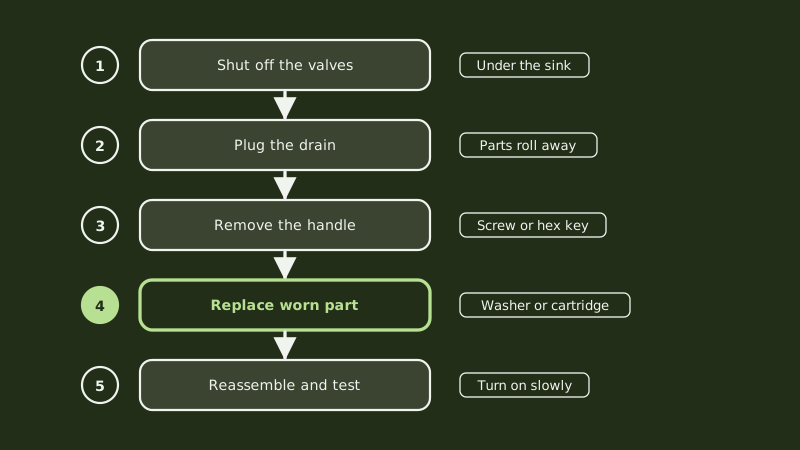
Close both stop valves below, open the faucet to bleed the pressure, and stop the drain so no screw disappears into it. Pop off the handle cap, take out the handle screw, lift the handle away, and unscrew the retaining nut or clip. Pull the washer, cartridge or ball assembly, match the new part, and reassemble in reverse order.
Detail by type:
- Compression: replace the rubber washer at the bottom of each stem and the O-ring, with a dab of plumber's grease.
- Cartridge: remove any retaining clip with needle-nose pliers, lift the cartridge straight up, note its orientation, and fit the new one the same way.
- Ball: a repair kit supplies the seats, springs and cam washer, so buy the full kit.
- Ceramic disc: replace the seals or the whole cartridge.
Take photographs as you go, and bring the old part to the store or order by model number: the wrong cartridge is a common reason a repaired faucet keeps dripping. When you turn the water back on, open the stops slowly, since a surge can crack a ceramic part.
Why does a faucet keep leaking after I replaced the part?
Usually a wrong or worn seat, a mismatched cartridge, a damaged valve seat that the new washer cannot seal against, or mineral scale. If water still passes the new part, the seat inside the faucet body is probably pitted and can be smoothed with a seat tool, or the faucet itself needs replacing.
Hard water plays a part here. The City of Santa Ana lists local tap water near 15 grains per gallon, and scale builds on seals, cartridges and aerators. Soaking removable parts in vinegar helps, and a stuck cartridge can need a puller. If the faucet is old and parts are scarce, a new fixture is often cheaper than a long repair. The broader how-to is on fixing a leaky faucet.
At what point does a plumber make sense?
Call when the stop valves will not close, when corrosion has fused the parts, when the leak comes from the supply lines or the faucet body, or when two attempts have not stopped it. Also call when the faucet is a premium or specialty model with parts you cannot match. A plumber will also check for hidden damage under the sink.
If the shutoff valves leak or will not turn, replace them first, since a faucet job on a failing stop valve can flood the cabinet. A faucet repair visit is typically a trip charge plus parts, and a replacement costs more. Get the price on paper, and check the contractor's record with the state licensing board. We arrange local plumbers for faucet jobs across the neighborhoods we serve.
Is a dripping faucet really a waste?
Yes. A steady drip wastes a surprising amount of water over a month, and it raises the bill and can stain the basin. No dependable average for a drip turned up, so measure yours: set a cup under it for ten minutes and multiply. The high water bill page lists other suspects to rule out.
Faucet leaks also hide: a leak inside the cabinet under the sink can soak the cabinet floor for weeks before you smell it. Check the stop valves and supply lines whenever you work on the faucet, and place a dry paper towel in the cabinet overnight to catch a weep.
Common questions
What is the time commitment?
A washer or O-ring swap runs roughly fifteen to thirty minutes, and a cartridge or ball repair thirty to sixty. Add time for stuck parts or a trip to buy the right one. Fitting a whole new faucet is longer, commonly an hour or two.
What do I need to buy to fix a leaky sink faucet?
Usually a repair kit or cartridge that matches your model, plumber's grease, and possibly a seat wrench. Bring the old part or the model number to the store. Basic tools are an adjustable wrench, pliers and screwdrivers. Cartridge pullers and seat tools are cheap and help on stubborn faucets.
Can the water stay on while I work?
No. Close the stop valves beneath the sink first. If none exist, or they will not close, shut the main supply where it enters the property. Open the faucet to release pressure before taking anything apart, since working on a live line risks a flood.
Is it better to repair or replace a leaky faucet?
Repair a newer faucet when only a washer, O-ring or cartridge is bad. Replace an old, corroded or discontinued faucet, or one that leaks from the body. A quality faucet is worth repairing, and a cheap one may cost nearly the same to replace. Ask the plumber what the parts will cost.
For the wider picture, start with plumber santa ana.
Sources
- Published faucet repair guides from retailers and plumbing suppliers, checked November 2026
- City of Santa Ana, water quality FAQs
Last updated