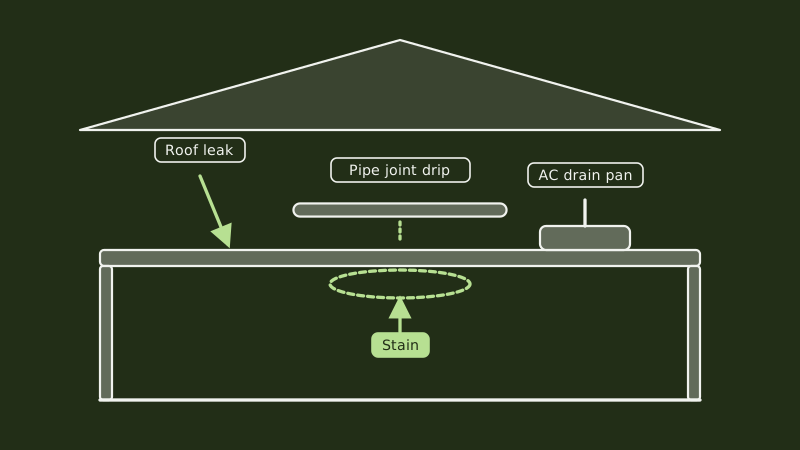
A stain is proof that water touched the ceiling. It is not proof that water is still arriving. Your task is sorting out which situation you are in: a single event that dried long ago, or a slow leak that wets the same spot now and then. Check the stain's edges, watch it for a few days, and run a meter test, all described below. If it grows, feels damp or comes back after drying, treat it as a live leak and think of burst and leaking pipes as the topic. The rest of our Santa Ana plumbing work is described on the home page.
Why would a ceiling stain show up with no drip?
Because the water that caused it came and went. A leak that ran only while someone showered, a roof that let rain through once, a pipe that sweated, or an old repair that has since dried can all leave a brown ring on the drywall. The stain stays after the moisture is gone.
Common culprits to consider:
- An intermittent plumbing leak from a shower pan, tub overflow, toilet seal or drain joint in the room above. It only drips when the fixture is used.
- A roof or flashing leak that appears in heavy rain and is dry the rest of the time.
- Condensation on a cold supply pipe, an air conditioning duct or a refrigerant line in the attic or ceiling space.
- A bathroom exhaust fan that blows into the attic and not outdoors, so moisture condenses and drips back.
- A pinhole leak in a supply line, slow enough that the drywall dries between wet spells.
- An old, fixed leak whose stain was never primed.
Which of these applies depends on your house. In Santa Ana, rain is occasional, so a roof leak may sit dry for months, and a stain under a bathroom or beneath an air handler deserves attention first.
Is the stain a past event or an ongoing leak?
Look at the stain's edges, touch it, and mark it. A dry, flat, light brown stain with a sharp edge is usually an old, finished leak. A stain with a soft, damp or bubbled spot, a darkening ring, or a rough texture suggests water is still arriving. Draw a pencil line around it and watch it for a week.

A short checklist:
- Press gently with a fingertip. Cool, damp or soft drywall means moisture. Dry and hard means old.
- Mark the outline and the date with a pencil. If it grows, it is active.
- Look for rings. Several nested rings show repeated wet and dry cycles from an intermittent leak.
- Sniff. A musty smell points to trapped moisture even if the surface looks dry.
- Use a moisture meter if you have one, or ask the plumber to. Readings are far more reliable than a guess.
- Compare with weather and fixtures. Does it darken after rain, a shower or a laundry load?
If you want a firm answer without a meter, try the water meter check: close every tap and appliance, read the meter dial or its low-flow indicator, and read it again a quarter hour later. Movement with everything off suggests a leak in the supply system. It will not catch drain leaks, which only occur when water runs.
What could be above the stain?
Think about what is directly overhead or just uphill of it. Water travels along framing before it drips, so the source may be some distance away, but the room above is the best first place to look. A bathroom, kitchen, laundry or air handler above a stain is a prime suspect.
Places to look, only where you can reach them safely:
- Bathroom above. Caulk and grout around the tub or shower, the shower door track, the toilet base and the water supply connections.
- Kitchen or laundry above. Dishwasher and washing machine hoses, the sink drain trap.
- Attic. Roof deck stains, damp insulation, ducts with water beads, and fan vents that stop short of the roof.
- Pipes in the ceiling space. Green or white crust on copper, a wet fitting, a weeping joint.
- Water heater in the attic or closet above, its drain pan and relief valve line.
Do not climb into an attic that has not been checked for safe footing, and do not step onto drywall. If the leak could involve wiring or a light fixture, keep power off in that area and read water leaking through a ceiling light.
Should I paint over the stain?
Not until you know the source is fixed. Paint hides a stain but not the cause, and painting over damp drywall bubbles and peels. Once the ceiling is dry, seal it with a stain-blocking primer, then repaint. If the stain bleeds back through, the leak is still active or the primer was too thin.
In order:
- Confirm the source is dealt with, by a plumber or roofer.
- Let the drywall dry completely, often a few days with a fan.
- Cut out and replace any section that is soft, crumbling or moldy.
- Apply one or two coats of stain-blocking primer.
- Paint the whole ceiling plane so the repair does not flash through.
A small stain on a ceiling that has been dry for a long time is largely cosmetic. A growing stain, a stained spot under a bathroom, or any sagging means the structure needs a look. For the broader picture of damaged ceilings, see ceiling damage from a water leak.
Is mold a worry when a ceiling stain is dry?
It can be if the area stayed damp. EPA says drying water-damaged materials within 24 to 48 hours prevents mold in most cases, so an old, quickly dried stain is less of a concern than one that has been wet for weeks. A musty smell, black or green spots, or a spreading stain point to mold.
If you see small spots of surface mold, they can often be cleaned from non-porous surfaces. On drywall, mold usually means the material should be cut out. Large areas, repeated moisture, or health symptoms call for a professional. Renters should report mold and moisture to the landlord in writing. Fixing the water source comes first, since cleaning without stopping the leak just leads to regrowth.
At what point is a plumber worth calling?
Make the call if the stain keeps growing, darkens after fixtures run, or the dial turns while everything is shut, if visible pipes are wet, or if you cannot locate the source. A plumber can run pressure and meter checks, use moisture and thermal tools, and trace the line. A stain from a roof leak calls for a roofer.
For leaks that are active, the steps to take for a ceiling leak lays out the first hour. The visit by a local plumber is set up by us, with the price agreed in writing beforehand. A quote of $1,000 or more falls under California's contractor license rule, so ask for the number and search it with the state licensing board.
Common questions
Can a ceiling stain appear with no leak at all?
Sometimes. Condensation from a cold duct or pipe, or a fan venting into the attic, can wet the ceiling without a pipe leak. A past leak that was fixed or dried leaves a stain too. If the stain does not grow and stays dry, it may be cosmetic. Watch it to be sure.
Why is the stain in a ring shape?
Rings form when water spreads, dries and leaves minerals and dirt at its edge. Several rings show repeated wet and dry cycles, which usually means an intermittent leak, such as a fixture above that leaks when used. A single ring suggests one event.
How do I find a slow leak in the ceiling?
Mark the stain's edge and watch it. Do the water meter test with everything off. Check the room above for loose caulk, tub overflows and toilet seals. A plumber carries a moisture meter and, if needed, a camera or pressure test, to find what you cannot see.
Will a water stain hurt my home's value?
A visible stain can raise questions in an inspection, so get the cause fixed and documented. A plumber's note, or a roofer's, helps. After repair, prime and paint the ceiling. In California, sellers have disclosure duties about known problems, and an agent or attorney can advise on yours.
Could this be a burst pipe without any dripping?
Unlikely. A burst pipe usually produces a lot of water quickly. A stain with no dripping points to a slow or intermittent leak, condensation or an old event. If the stain grows fast or water appears, close the main valve and follow the ceiling leak steps.
Sources
- EPA, A Brief Guide to Mold, Moisture and Your Home
- Published 2026 home inspection and plumbing guides on ceiling stains, checked November 2026
Last updated