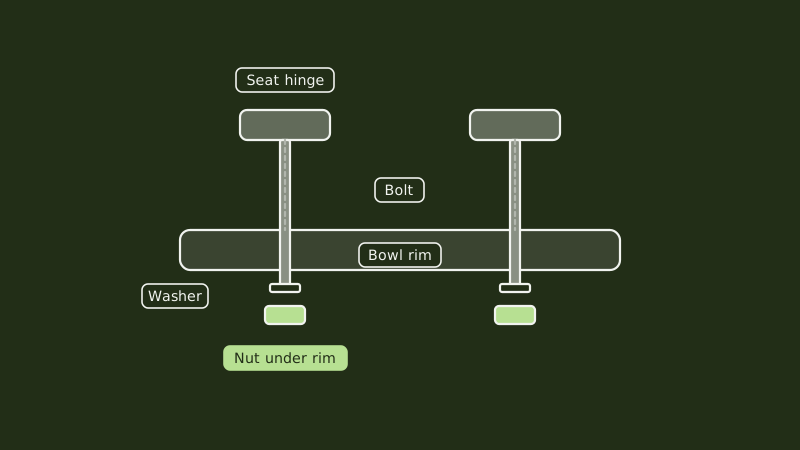
Snug up the pair of hinge bolts behind the bowl and the seat stops wandering. The trick is that the nuts holding them often sit underneath the rim, hidden behind plastic caps. Find them, hold the bolt still on top while you turn the nut below, and snug both sides evenly. If the seat still slips, replace the hardware. Bigger repairs, like the toilet itself rocking, belong on the toilet repair page.
What makes a seat drift sideways?
Because the two hinge bolts have worked loose, or the plastic and rubber parts around them have worn smooth. Years of sitting, lifting and cleaning shake a nut a fraction of a turn at a time. Hard water scale can also coat the threads. The seat then pivots on the bolts instead of staying put.
Another cause is a mismatched seat. Round seats fitted to elongated bowls, or the reverse, leave the bolts off-center in their slots, and the seat never grips. Check the shape of your bowl and the seat you bought, and look at the bumpers beneath the seat too: missing rubber feet let it skate on the porcelain.
Which tools and parts should I gather?
A flat or Phillips screwdriver, slip-joint pliers (or an adjustable wrench), a cup for small parts, and a rag. If the nuts are corroded, a little penetrating oil helps. Wear gloves, since the underside of a toilet rim is not pleasant. A flashlight or phone light shows the nuts under the bowl.
Look at the caps first. Most seats have a plastic cover over each bolt head at the back; pry it up with a fingernail or a small screwdriver. Two styles exist: top-mount seats, where a bolt goes through the bowl and a nut sits below, and bottom-mount or quick-release seats, which clip on and off with a catch. The fix differs slightly, as the next section shows.
How do I tighten a top-mount seat?
Flip up the caps, pin each bolt head with a screwdriver, and turn the nut under the rim with pliers or your fingers until the seat holds. Alternate sides so the seat stays centered. Stop when snug: plastic hardware cracks if overtightened, and porcelain can crack too.
If the bolt spins without catching, the nut is stripped or the bolt is bent. Take the seat off and fit new bolts, which come in seat repair kits and match most standard seats. Before you retighten, wipe the threads and the seat's mounting holes. If the hole has stretched, a washer on top of the bolt can help hold the seat in place.
The three common styles:
- Plastic bolts and nuts: cheap and easy to strip. Replace as a set.
- Metal bolts and plastic nuts: hold better, but the nut can crack.
- Brass or stainless bolts: last longest; use a rag and a little oil if corroded.
What if the nuts are stuck or the bolts spin?
Pin the bolt head, grip the nut with pliers, and brush on penetrating oil if rust is in the way. If the bolt will not hold, a plumber or hardware store can cut a stuck bolt with a hacksaw blade slipped between the seat and the bowl, with a strip of tape on the porcelain to protect it.
Cutting is a last resort, and a careless slip scratches the bowl. Corroded brass is the usual cause where moisture lingers. Santa Ana tap water runs about 15 grains per gallon, per the City, and scale can lock up nuts under the bowl, so a few minutes with penetrating oil before turning saves a lot of effort. If the bolt keeps turning with the nut, switch to a seat style with a quick-release and replace the whole set.
Is it the seat that moves, or the whole toilet?
Sit the seat aside and grab the bowl itself. If the porcelain moves against the floor, the problem is not the seat: it is the closet bolts or the wax ring seal below, and the toilet should not be left to rock. That seal also keeps water in, and a leak at the base can follow. Our page on tracing a toilet leak is the next stop.
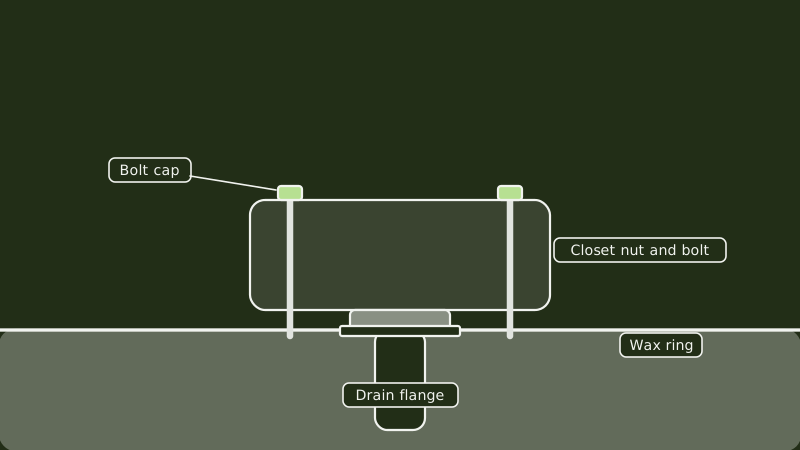
A rocking toilet is more urgent than a sliding seat, because movement can crack the wax seal and the flange, and a failing seal can soak the floor. Tightening the two bolts that hold the bowl to the floor sometimes cures it, but a plumber should check for a gap or a cracked flange. For the do-it-yourself side of leaks, see repairing a leaking toilet.
When should I replace the seat instead of fixing it?
When the hinges are cracked, the seat itself is split or stained beyond cleaning, the bolt holes have stretched out, or the hardware keeps loosening within weeks. A new seat usually costs less than a plumber's visit and takes about the same time as a tightening job. Buy one that matches your bowl's shape: round or elongated.
To pick a seat, measure from the hinge holes to the bowl's front edge, then compare it with the size on the box. Quick-release styles remove with a button for cleaning, which many people like. Soft-close hinges slow the lid. Skip the very cheapest models if you plan to keep the toilet, since their hinges tend to wear sooner.
Does a loose seat mean anything is wrong with the plumbing?
No. A loose seat is a hardware problem, not a plumbing fault. The tank, the flush valve and the connection to the drain are separate parts. If your toilet is also running or leaking, those are independent faults, and the page on a running toilet deals with them. We arrange plumbers across our service areas for those.
Common questions
How much time does the fix need?
Around ten minutes when the nuts turn freely, and half an hour if they are corroded or the bolts need replacing. Allow a little longer if you are fitting a new seat. The water stays on throughout, and no special tools are needed.
Can I fix a toilet seat without getting under the bowl?
Often not, because the nuts sit beneath. Some seats use a top-access system, where you tighten from above with a screwdriver, and bottom-mount models release with a catch. If you cannot reach, a basin wrench or a long-reach socket helps. Check the packaging of the seat you own.
Is a plumber required for this?
No, it is a simple household repair. Book one only if the toilet itself rocks, water appears at the base, or the bowl is cracked. Those point to a failing seal or damaged flange, not to the seat, and they are not safe to leave.
What size toilet seat do I need?
Toilet bowls are either round or elongated, and the seat must match. Measure from the hinge holes to the bowl's front lip and across its widest point, then compare with the product size. Many seats list a range. If unsure, carry the old seat to the store.
For the wider picture, start with the plumber guide for Santa Ana.
Sources
- Published toilet seat and toilet repair guides from manufacturers and plumbing suppliers, checked November 2026
Last updated